Chapters Of Our Story
From The Pages of Towers
There are a lot of things one can learn about Otterbein’s story by reading old issues of Towers. What were the University’s priorities? How were academics and the face of campus changing? This is a glimpse of some of the highlights — you can explore more in these issues and others.
1930s: The Great Depression impacted finances.
October 1931 “Along with many other colleges, Otterbein suffered a drop in her Freshman Class.”
October 1931 Homecoming game vs. Capital, Oct. 17, 1931. “Capital beat the Big Tan Team last year and our boys are out this year to reverse the score. Polish up Dobbin’s harness, grease the old buggy, get Sally and the children in and be here for the Big Day.”
August 1932 A letter from President Walter G. Clippinger read, in part, “There are fifty-five young people on our list of prospects who cannot come to Otterbein or any other college without special help. It will take $5,000 in gifts and loans to bring them here.”
December 1935 Students led a trial run for co-ed dining. “Generally, the opinions concerning the innovation were quite favorable, many stressing the fact that it was not only good social training but also an excellent opportunity for them to become better acquainted with their school colleagues.”
September 1939 The freshman class enrollment was the largest since 1926-27; total enrollment was 418 students.
1940s: World War II defined campus life.
March 1946 A campaign was announced to build Memorial Stadium in honor of the 13 men and one woman from Otterbein who lost their lives serving in World War II.
December 1946 The 1946 football team, filled with veterans, had the most successful year in Otterbein history. “Otterbein enjoyed a perfect conference record and is the undisputed champion of the Ohio Conference.”
March 1948 The “OtterBarn” became the first student union. It was 5,000 square feet with a lounge, reading room, and snack bar. It was formerly a non-commissioned officers’ club at Camp Reynolds, PA.
March 1948 Otterbein’s WOBC radio station hit the airwaves. “Recorded and live music, campus news and sports, and chapel and church services will be heard on the daily broadcasts.”
1950s: Facilities and faculty fueled academic expansion.
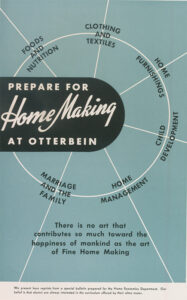
March 1950 A feature on the Home Economics program claimed, “There is no art that contributes so much toward the happiness of mankind as the art of Fine Home Making.”
September 1951 Cowan Hall was built, thanks to a gift from Clyde E. Cowan, class of 1904.
December 1954 Schear Greenhouse was dedicated to Professor Edward Waldo Emerson Schear, who retired in 1951 after 39 years of service.
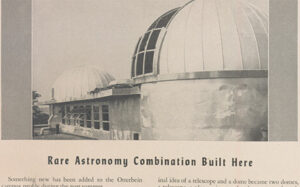
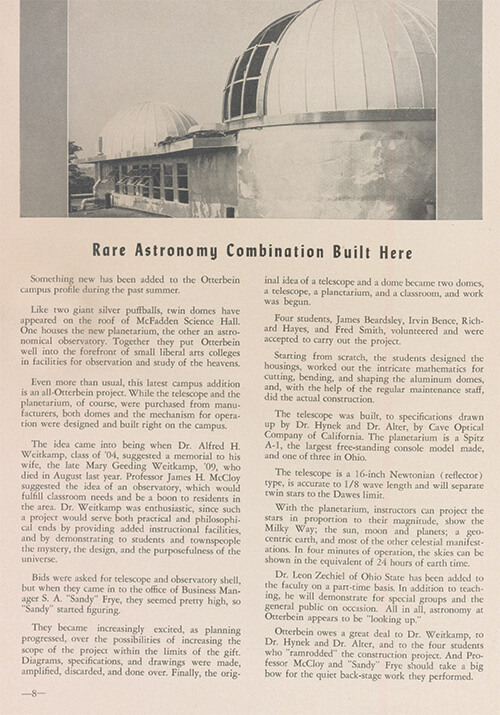
September 1955 Weitkamp Observatory was built. “Like two giant silver puffballs, twin domes have appeared on the roof of McFadden Science Hall. One houses the new planetarium, the other an astronomical observatory. Together they put Otterbein well into the forefront of small liberal arts colleges in facilities for observation and study of the heavens.”
March 1956 There was a contest to name “Academic Hall,” formerly the “Administration Building.” In the June 1956 issue, it was announced that the building was renamed “Towers Hall.”
Professor LaVelle Rosselot revolutionized language learning by creating a French-language film series (May 1956 and January 1959), then established one of the first language laboratories (April 1959).
1960s: As global travel became easier, Otterbein’s worldview expanded.
July 1961 Towers featured commencement speaker John Albert Musselman Karefa-Smart ’40, minister of external affairs and defense of Sierra Leone. (See cover on timeline page 8.) In October 1961, Towers reprinted an article about the event in The Chicago Sun-Times, “Contributions of a Small College”.
January 1964 The first study abroad class wrote about their time in Strasbourg, France.

Spring 1967 First Otterbein Summer Theatre season was announced.
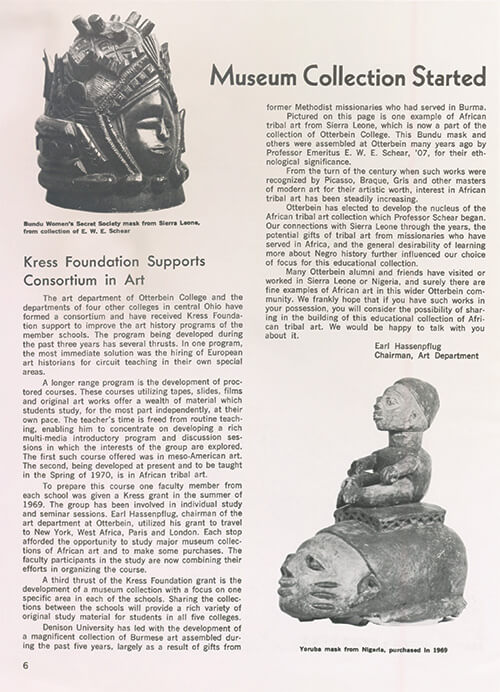
Summer 1969 Otterbein’s African art collection was officially established with a grant from the Kress Foundation.
1970s: Social movements spread on campus.
Spring 1970 Otterbein became the first university to add faculty and student members to the Board of Trustees. The New York Times covered the story, “Ohio College Puts Students on Board of Trustees”.
Winter 1970 The nation’s top consumer guardian, Ralph Nader, discussed environmental hazards at a campus convocation.
Spring 1971 The Board of Trustees allowed the creation of sorority houses on campus. By the Summer 1974 issue, Otterbein dropped the policy of setting women’s residence hall hours in favor of a card key system that allowed women to enter residence halls after “closing hours.”
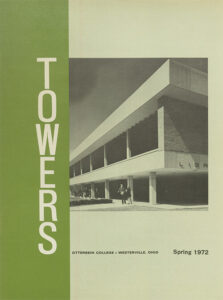
Fall 1975 New academic programs include the adult degree program; bachelor’s programs in equine science and stable management (Summer 1976); bachelor of fine arts (BFA) in theatre (Spring 1977); and bachelor of science in nursing (Fall 1978).
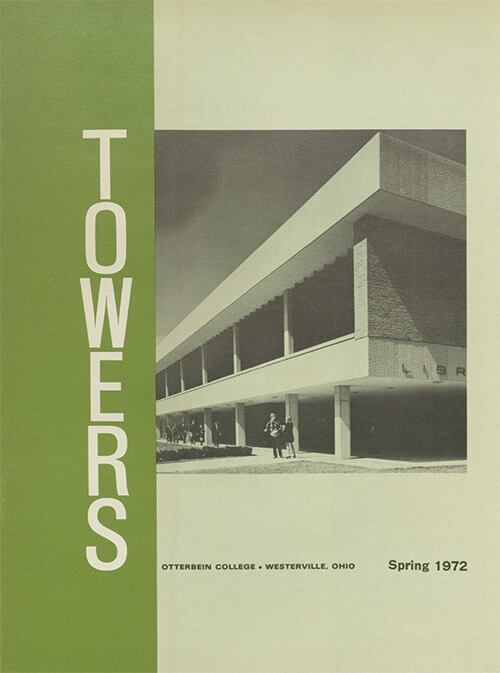
New building projects included Courtright Memorial Library (Spring 1972); Rike Center (Summer 1975); and Battelle Fine Arts Center (Spring 1979).
1980s: Pop culture and new programs gained popularity.
Spring 1982 “Otterbein College was featured as the location for Arthur Carlson’s 25th class reunion on… ‘WKRP in Cincinnati.’ The reunion show, entitled ‘You Can’t Go Out of Town Again,’ revolved around the return of station manager Carlson and his wife to Otterbein where they reminisced about the early days of their courtship. Gordon Jump ‘55, who plays Mr. Carlson, is an Otterbein alumnus.”
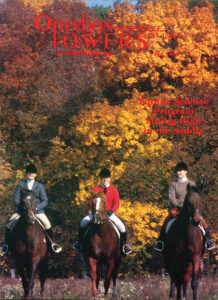
Winter 1983 The new equine riding team competed for the first time in the Intercollegiate Horse Show Association (IHSA). The team won its first national championship in its third year of competition.
Summer 1983 Joanne Van Sant choreographed her 29th musical. “Otterbein’s own triple threat, ‘Dean Van’ serves as vice president for student affairs and dean of students, as an associate professor of health and physical education, and as choreographer for Otterbein College Theatre and Otterbein Summer Theatre.”
Spring 1989 President C. Brent DeVore H’86 discussed new master of arts in education (MAE) and master of arts in teaching (MAT) programs.
1990s: Community outreach became a campus priority.
Otterbein established mentorship programs to encourage college attainment in underserved schools, including the Linmoor-Otterbein Scholars Program (Fall 1991) and the Indianola After-School Program (Spring 1998).
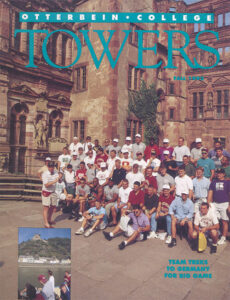
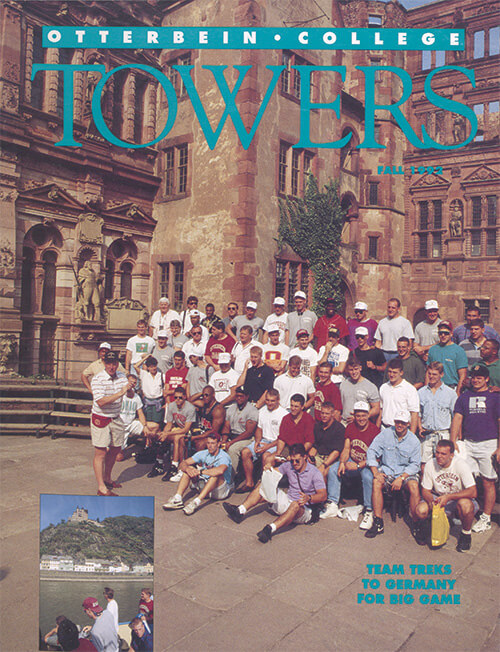
Fall 1992 Otterbein and Heidelberg University football teams traveled to Germany to play the “Rhine River Classic,” which ended in a 7-7 tie.
Summer 1993 The Edwin L. ’47 and Marilou ’45 Roush Hall was dedicated.
Fall 1993 The Fall Faculty Conference topic was “Integrating Service/ Community Learning into the Classroom.” By Winter 2009, there were 90 service-learning courses.
Summer 1995 Mary B. Thomas ‘28 endowed The Thomas Academic Excellence Series, or Common Book.
Winter 1997 Republican presidential candidate Bob Dole held a rally at the Rike Center on Oct. 22, 1996.
Winter 1999 They Might Be Giants performed at Otterbein on Jan. 29, 1999.
2000s: Advances in athletics and changes in leadership.
Spring 2000 The Vernon L. Pack ’50 Distinguished Lecture and Scholar-in-Residence Series was established.
Spring 2002 The men’s basketball team won the NCAA Division III National Championship under Head Coach Dick Reynolds ’65.
Winter 2003 Clements Recreation Center opened.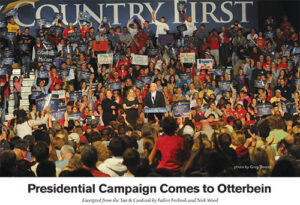
Fall 2008 The inaugural class was inducted into the Athletic Hall of Fame.
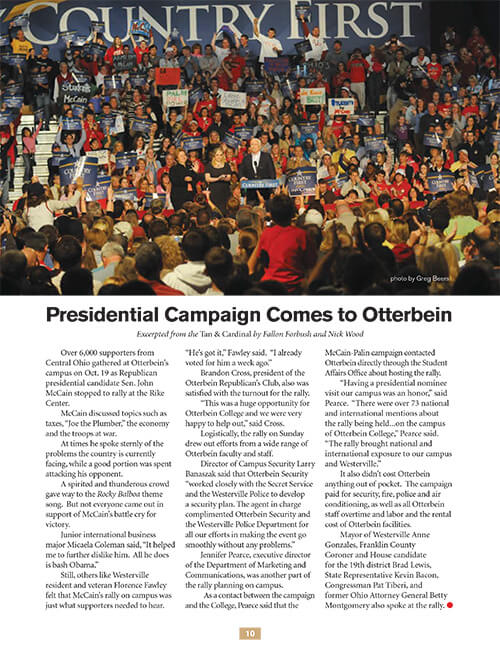
Fall 2008 Sen. John McCain held a rally at the Rike Center on Oct. 19, 2008.
Spring 2009 President C. Brent DeVore H’86 retired after 25 years.
Fall 2009 Otterbein’s first woman president, Kathy A. Krendl H’18, was inaugurated.
2010s: Creating programs for the future.
Spring 2010 Otterbein College became Otterbein University again.
Fall 2012 The Austin E. Knowlton Center for Equine Science was dedicated.
Spring 2013 First class of Zoo and Conservation Science began in the fall with practicum opportunities at the Columbus Zoo and the Ohio Wildlife Center.
Summer 2014 Systems Engineering major was launched.
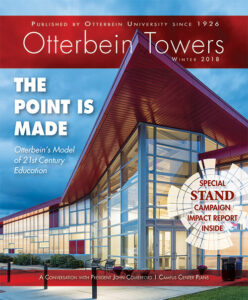
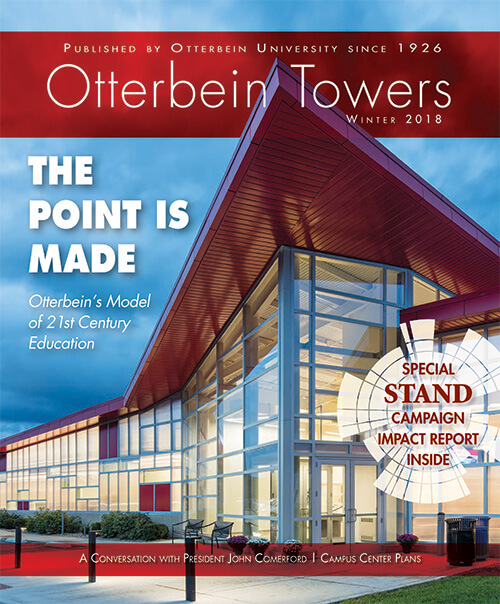
Fall 2016 The Point at Otterbein officially opened.
Spring 2018 President Emerita Kathy A. Krendl H’18 retired after nine years.
Winter 2018 The Where We Stand Matters campaign raised $52,775,000 from more than 10,000 donors.
Spring 2019 President John Comerford was inaugurated.
Fall/Winter 2019 CNN and The New York Times hosted the Democratic Presidential Primary Debate on campus in October 2019.
2020s: As for the 2020s, history is still being written.