
THE SCOTTISH HISTORIAN AND PHILOSOPHER THOMAS CARLYLE ONCE SAID, “HISTORY IS THE ESSENCE OF INNUMERABLE BIOGRAPHIES.” SOME OF THOSE BIOGRAPHIES — THE STORIES AND EXPERIENCES OF OTTERBEIN STUDENTS, ALUMNI, FACULTY, AND STAFF WHO LIVED THROUGH HISTORICAL EVENTS — HAVE BEEN TOLD ON THE PAGES OF TOWERS THROUGH THE DECADES.
World War II
World War II
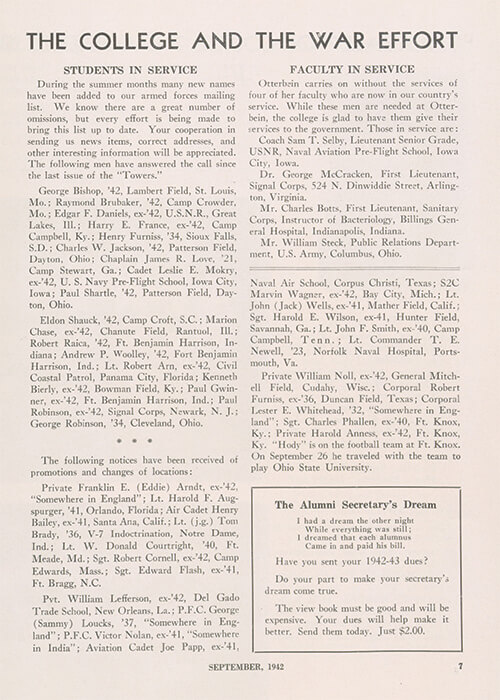
The first signs of World War II appeared in the September 1941 issue of Towers, with a list of 23 men called “In the Army Now.” The U.S. entered WWII in December 1941. Subsequent issues included news of Otterbein men and women serving in the military — from happy news of promotions and “furlough brides,” to sad news of those who were prisoners of war, missing in action, and killed in action.
In April 1942, in addition to the news that Sam Selby, the athletic director and head coach of football, basketball, and baseball, had been drafted to serve in the Navy, there was an “S.O.S. to All Alumni” about the enrollment and financial declines the college was facing due to the war.
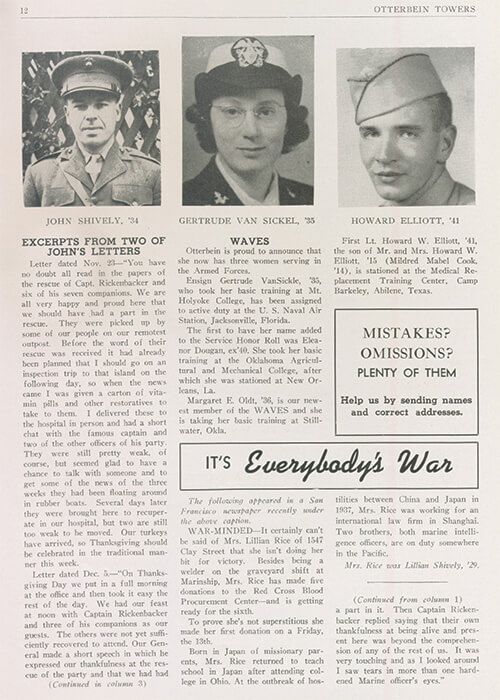
By March 1943, Otterbein had “given up six professors” and “sent forth 221 known graduates and students to the different branches of the service.”
Otterbein was operating classes year-round to accelerate programs for students in the reserve corps and offering courses necessary to the war effort, including radio, meteorology, pre-medical, and pre-engineering. Otterbein was also offering facilities, equipment, and teachers to the government for use in officer training programs.
Starting with the September 1943 issue, Towers was sent to all service members with addresses on file, no matter where they were stationed, with the hope that news from home would lift their spirits.
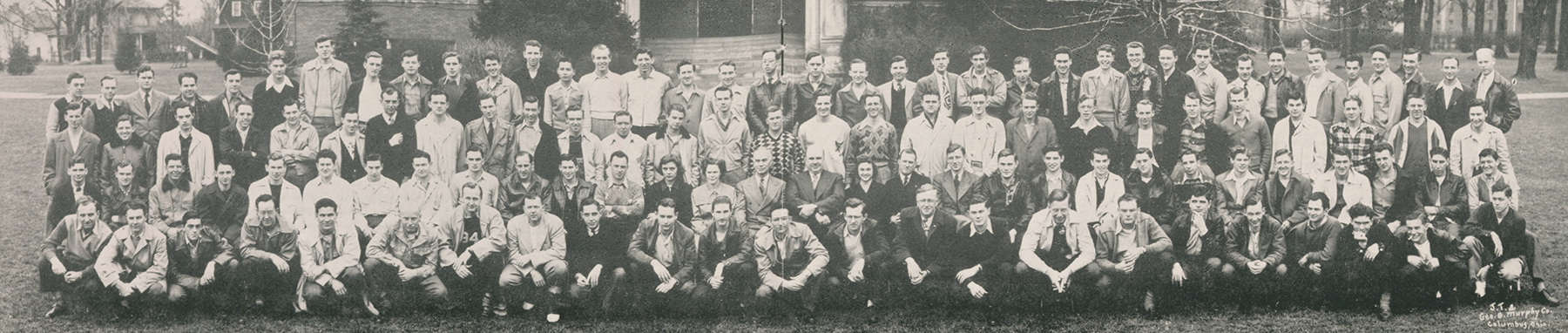
“…Some of the One Hundred Sixty Veterans Now Enrolled at Otterbein College” March 1946 Towers
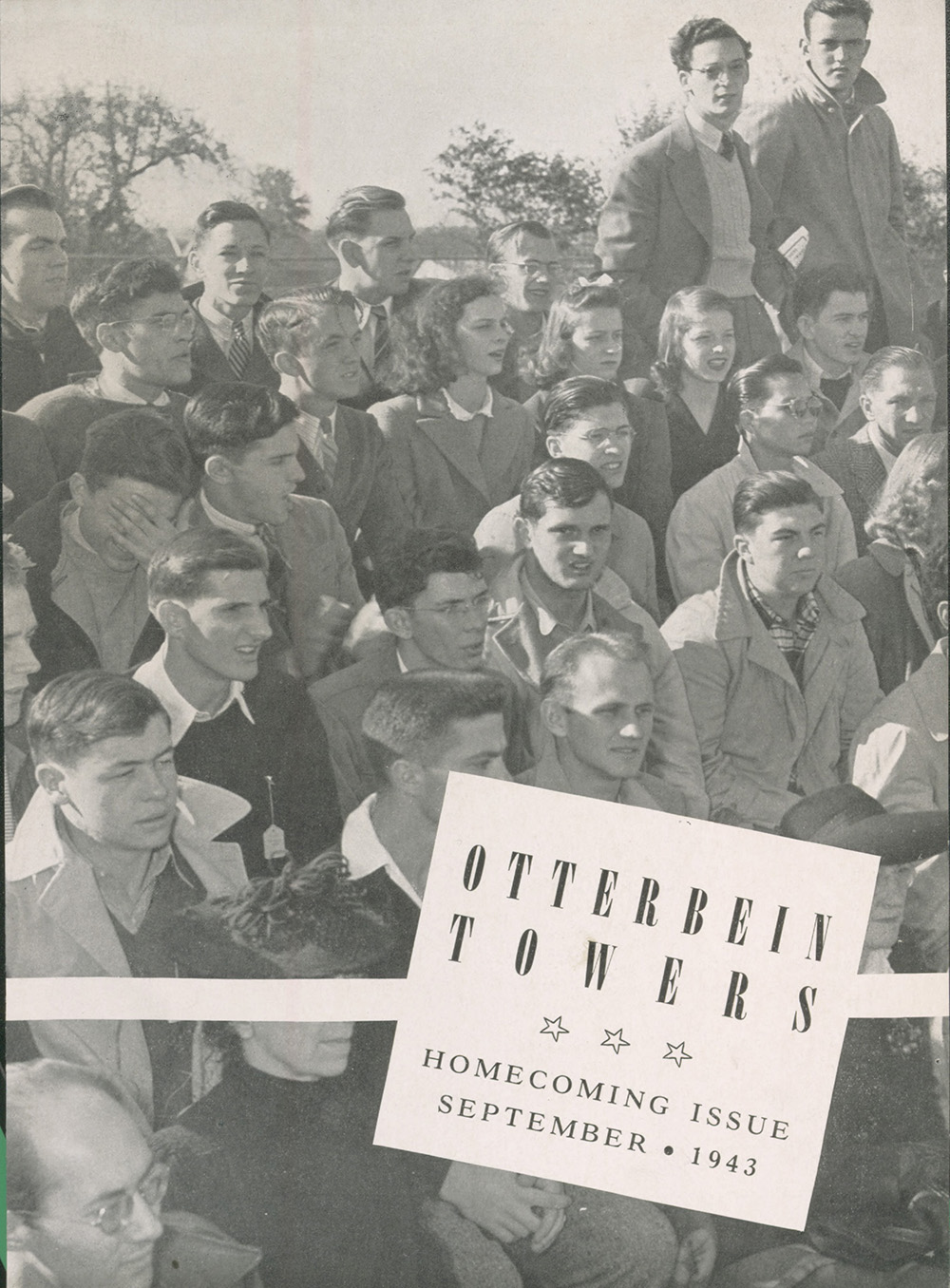
When the war in Europe ended in May 1945 and in the Pacific later that year, American soldiers returned home in large numbers. The September 1945 issue chronicled the Homecoming celebrations that welcomed home the veterans, and later issues would list veterans who had returned to civilian life — and boast of record enrollment numbers.
In the same issue, a short article stood out from the rest: “We know of several Otterbein people who have worked on the production of the Atomic Bomb. There are probably many more. Since May 1943, Gilmore Crosby, ’43, has worked for the Eastman Kodak Company, first at Rochester, New York, and later at Oak Ridge, Tennessee, where he was a supervisor in the plant. Dr. John Flanagan, ’38, spent two years at the University of Chicago in research work and is continuing in Dayton at Monsanto Chemical Company. Allen Bartlett, ex’44, has for fifteen months been employed as a physicist at the New Mexico experimental base. We can all hope that the results of their labors may be for the benefit of humanity.”
Vietnam War
Vietnam War
During the Korean War years, Towers included a special news section for alumni who were serving in the military, but the Vietnam War mobilized students on campus as well as those serving overseas.
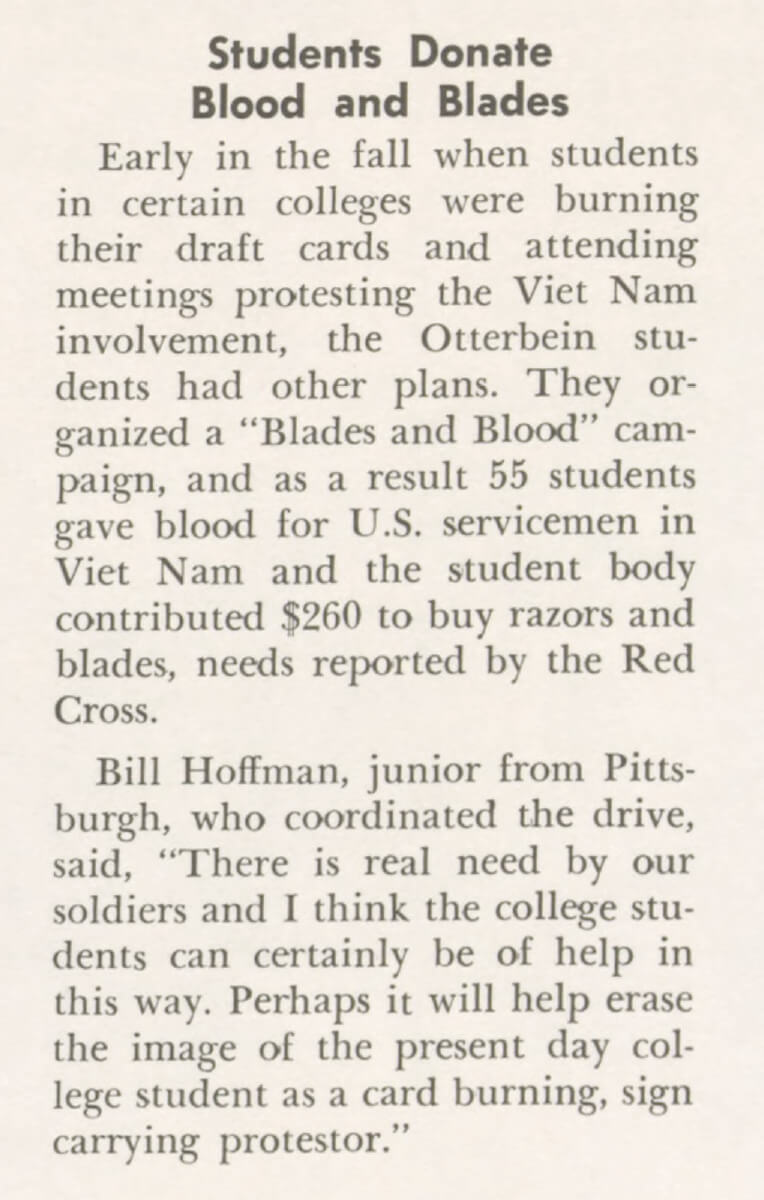
The January 1966 issue of Towers included an article about a “Blades and Blood” drive in which “55 students gave blood for U.S. servicemen in Viet Nam and the student body contributed $260 to buy razors and blades . . . .”
In Spring 1968, Towers reported on a book and toy drive by a student group called Angel Flight of Otterbein:
“The project began several months ago when Miss Nikki Katsilas (Schlonski ’71), sophomore from Pittsburgh, wrote to Major Robert Warner, 1956 graduate and navigator in the 16th Tactical Reconnaissance Squadron, South Vietnam, requesting permission for the Angel Flight to ‘adopt’ his outfit . . . In his letter of permission, Major Warner noted that, although the servicemen could use books, they were in need of toys for children at the Ky Quang Orphanage near Saigon, which the squadron was assisting.”
These stories of support countered the sad news of Otterbein alumni or students wounded or killed in action and, closer to campus, the tragedy at Kent State University.
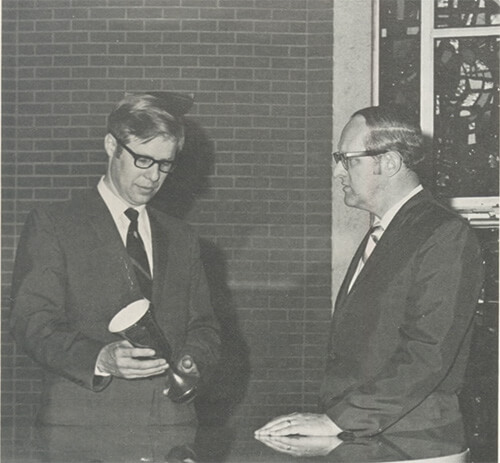
L-R: Rev. Duane Frayer ’53 was a Methodist minister who served Kent State students at the time of the shootings. Soon after, he handed his responsibilities to Rev. Donald Shilling ’54 .
On May 4, 1970, four unarmed college students were killed and nine wounded when the Ohio National Guard shot into a crowd of anti-war demonstrators at Kent State.
The shooting at Kent State was followed by a massive national student strike that shut down over 400 colleges and universities, but according to the Spring 1970 issue of Towers “a strike was avoided at Otterbein when the faculty passed an alternate proposal that all classes on Friday be devoted to talking about the war and other major national issues.”
Otterbein students shared opinions openly as a community, and anti-war students held a memorial service and organized a letter-writing campaign to Congress members and a peace march.
The Berlin Wall
The Berlin Wall
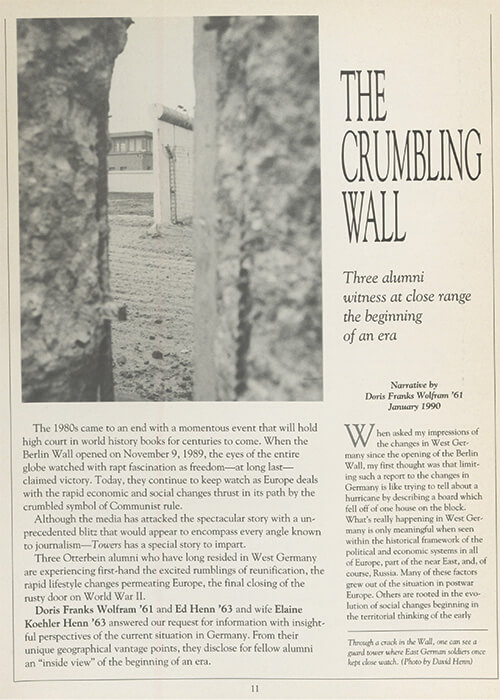
When the Berlin Wall “fell” on Nov. 9, 1989, the entire world celebrated. Three alumni were watching from a unique vantage point: West Germany.
Doris Franks Wolfram ’61 and Ed Henn ’63 and his wife, Elaine Koehler Henn ’63, shared their perspectives in essays in the Spring 1990 issue of Towers.
Wolfram shared, “Hardly any of (the East Germans) were really prepared for the overwhelming amount of various products available and the attractive and colorful packaging and advertising. One woman stood in the supermarket with her daughters and wanted to buy a bar of soap to take back. She picked up one brand of soap after another, smelled it, laid it back on the shelf and picked up the next and then the next. In the end she laid them all back and said, ‘I don’t think we’re up to this yet.’”
The Henns wrote, “Americans at many U.S. military installations in ‘Vest’ Germany established collection points for donated clothes and toys to send to East German relocation centers in the West. During December, programs were established which encouraged American military personnel to invite East Germans into their homes for the holidays. Many negative images of Americans held by the East Germans were changed during these visits.”
Operation Desert Storm
Operation Desert Storm
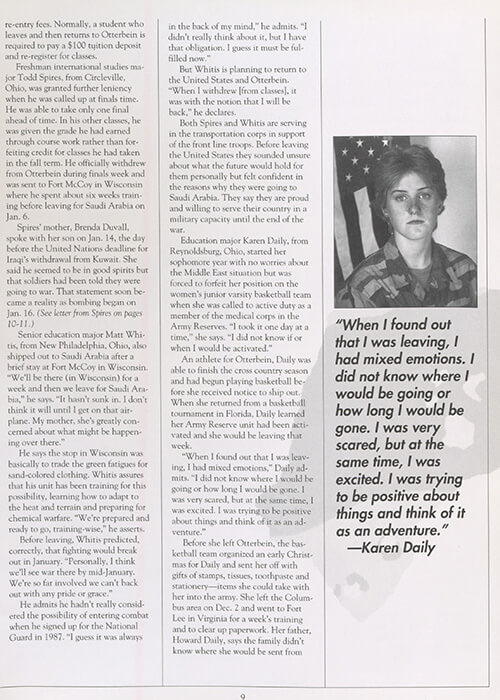
When Iraq invaded Kuwait on Aug. 2, 1990, the United States responded and many reservists were called to active duty, including seven Otterbein students. The Winter 1991 issue of Towers interviewed not only the students, but also alumni who were called to active duty, their families and supporters, and alumni with ties to the Middle East.
Many of the students were surprised to be called to active duty: “Senior education major Matt Whitis (’08), from New Philadelphia, OH, shipped out to Saudi Arabia after a brief stay at Fort McCoy in Wisconsin. He admits he hadn’t really considered the possibility of entering combat when he signed up for the National Guard in 1987.”
The issue included an interview with a student from Kuwait who appreciated the Otterbein servicemembers: “Nora AbuZeid, a freshman international business and computer science major at Otterbein, does support the United States war effort because she wants to return to her home in Kuwait . . . Her parents left Kuwait a week before the invasion with only enough packed for a two-week trip . . . (They) had no idea their country would be overrun during their absence.”
Sept. 11, 2001
Sept. 11, 2001
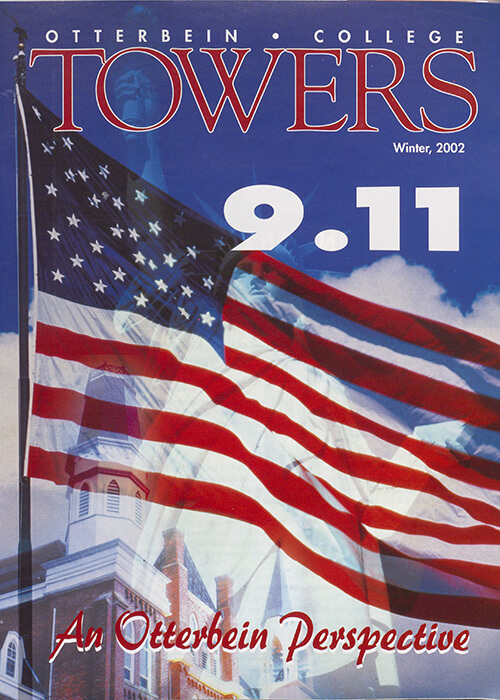
For the readers who are old enough to remember 9/11, it’s impossible to forget the deep impact the tragic events had on Americans across the nation, around the world, and right here at Otterbein. On campus, the community came together in a show of support, and faculty used their classes to address issues that arose after the attacks.

The Concert Choir and Vocal Ensemble performed “The Battle Hymn of the Republic” and “Give Me Jesus” under the direction of Gayle Walker at Ohio Stadium on Sept. 15. Ohio State was not yet in session, so Otterbein’s students were asked to sing for a crowd of 10,000 with just one day’s notice. The event raised $700,000 for victims.
In addition to covering the campus response, the Winter 2002 issue of Towers gave alumni a chance to share their stories. Christine Witt ’00 was on the Staten Island Ferry at the time of the attack and witnessed the second plane hit the World Trade Center. Karlie Mossman ’95 was walking to work near the World Trade Center. She came out of the subway to see pieces of the first tower floating in the sky, only to witness the plane hit the second building.
Gen. Lance W. Lord ’68 (Ret.) and Maj. Gen. Glen D. Shaffer ’70 (Ret.) were both in the Pentagon when it was hit by the third airliner.
Ben Hodges ’91 lived near Ground Zero in New York City and shared his viewpoint about life during and after the attack in a moving essay.
Hurricane Katrina
Hurricane Katrina
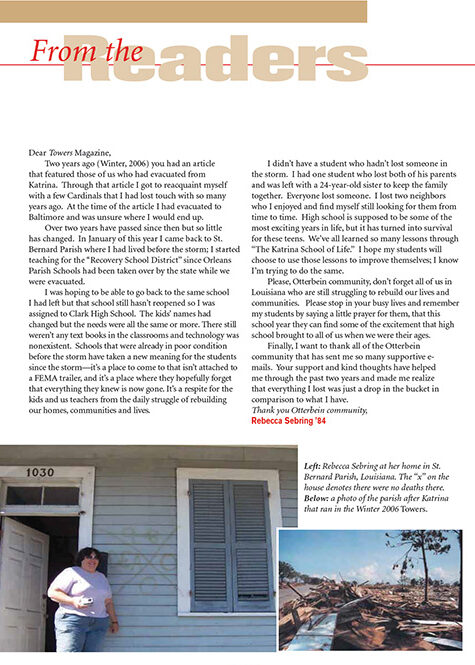
Tragedy hit the nation again when Hurricane Katrina made landfall in Louisiana on Aug. 29, 2005, and devastated the area in and around New Orleans. In the Winter 2006 issue, alumni who lived through it and students who went to help in the aftermath shared their stories.
The stories included Rebecca Sebring ’84, who taught special education in the now-infamous Ninth Ward, one of the poorest and hardest hit districts, and Jay R. Hone ’75 and Marty Davis ’73, two Air Force reservists who lived across from each other as students at Otterbein and served together by chance in Louisiana after the hurricane.
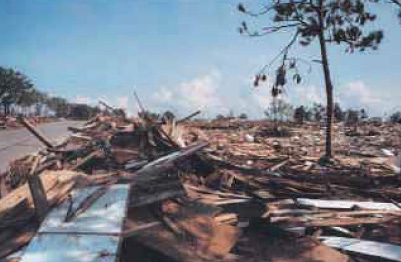
Photo of Parish after Katrina that ran in the Winter 2006 Towers.
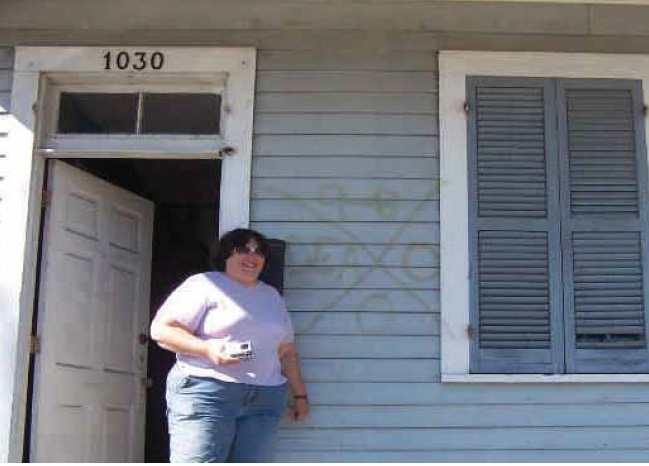
Rebecca Sebring at her home in St. Bernard Parish, Louisiana. The “x” on the house denotes there were no deaths there.
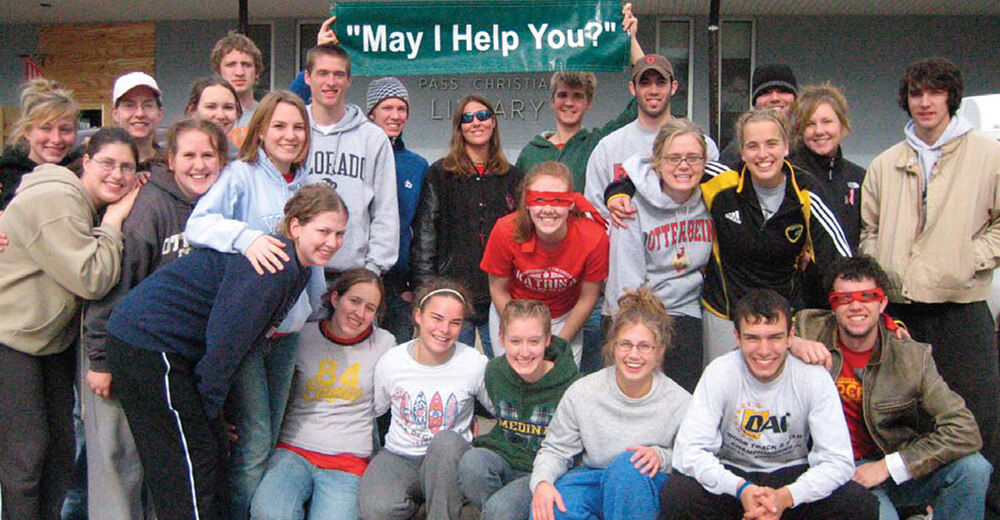
Many students were also on the ground, assisting the victims of Katrina. Sophomore Matt Lofy ’08, a U.S. Coast Guard Reservist, was called to active duty in New Orleans, while sophomore Tom Dodge ’08, a National Guardsman, was deployed to Mississippi. Additionally, 25 students from the Otterbein Christian Fellowship traveled to Mississippi during their winter break to volunteer.
These are just a few of the many historical events you can read about in the past 100 years of Towers. We hope this serves as a launching point for history enthusiasts to read the full articles and discover more stories of interest. Visit: digitalcommons.otterbein.edu/towers