Interview with Melissa Dawn Simkins ’99

Interview with Melissa Dawn Simkins ’99

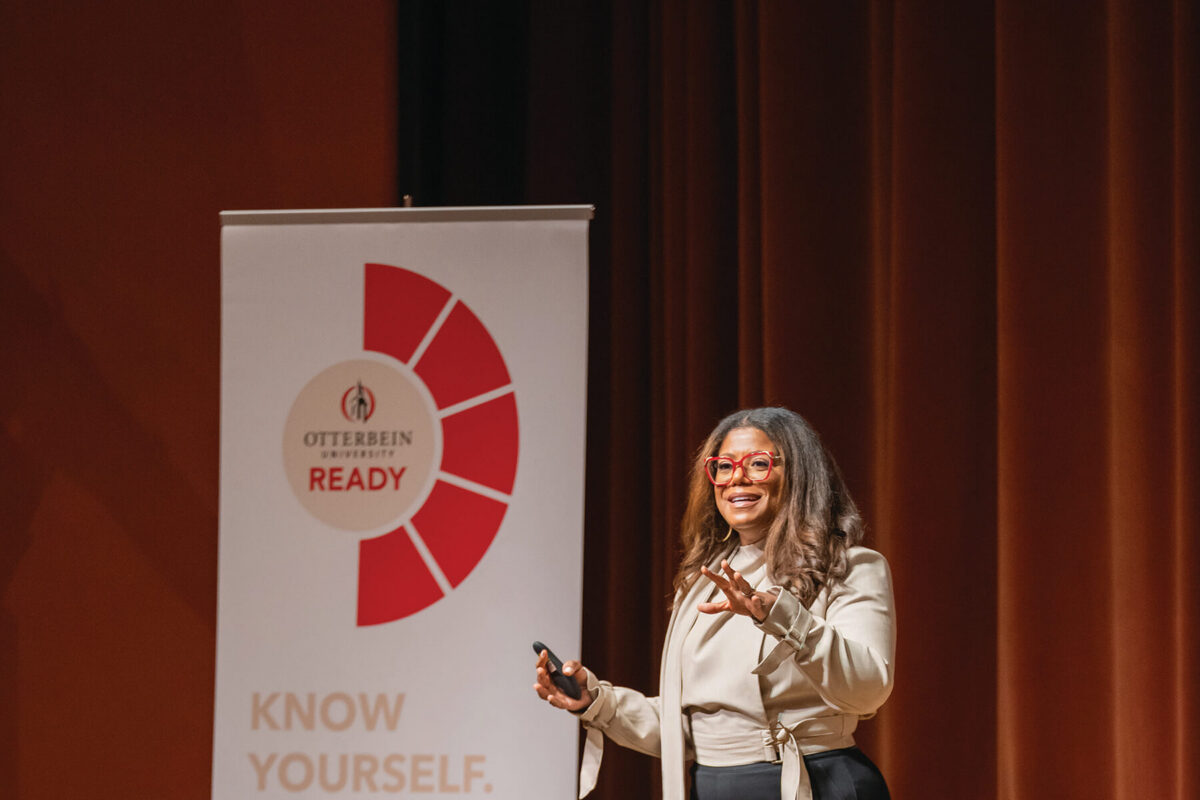
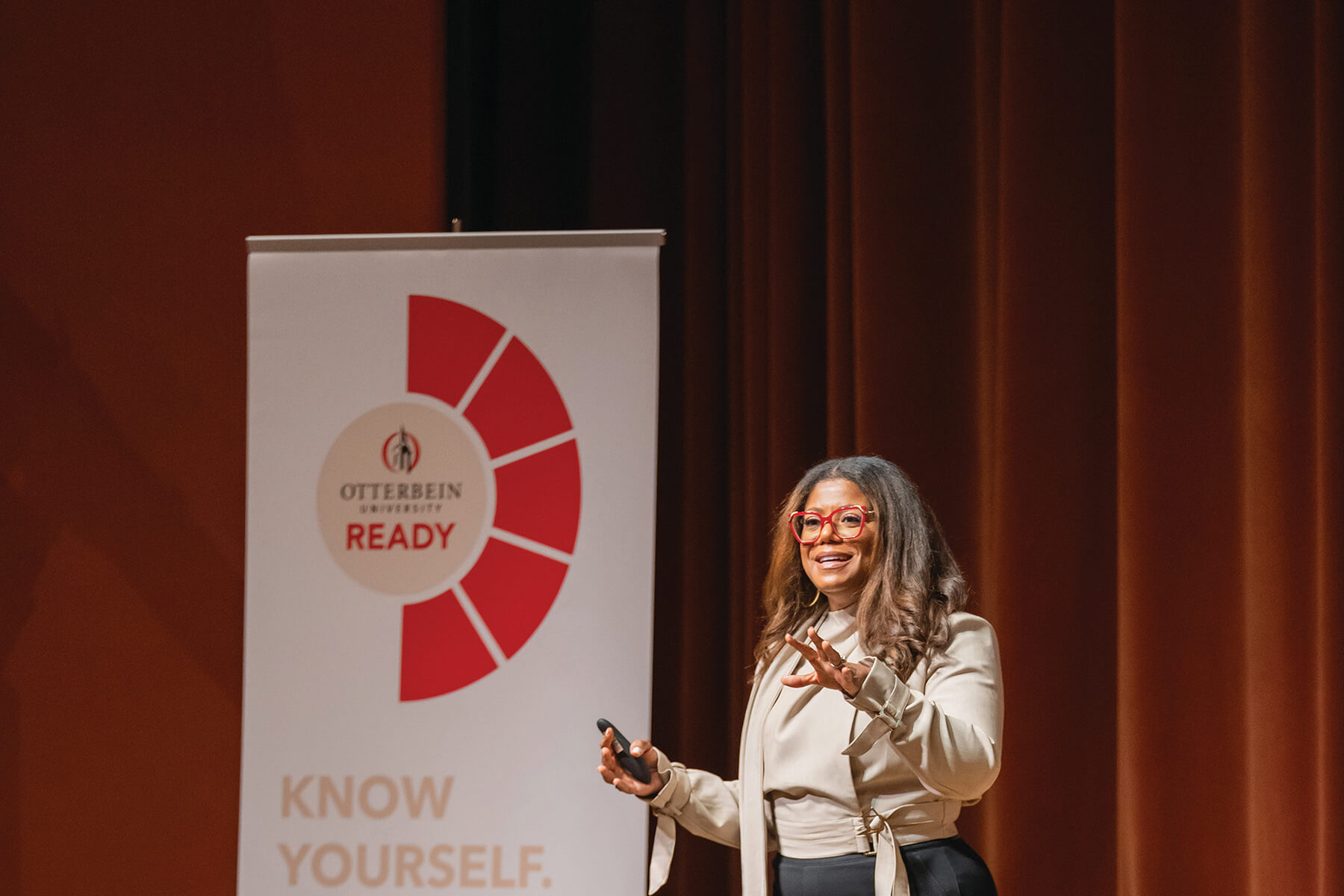
Recently, AJ Najy ’27, an English and Music Performance major with a minor in Women’s, Gender, and Sexuality Studies had the opportunity to interview Melissa Dawn Simkins ’99, author of the Athleadership program and the new book Athleadership: The Elite Athletic Mindset: How to Lead Under Pressure and Perform When It Counts.
Class of 1999 Public Relations &communications Major

Q.What did your time at Otterbein look like? Which clubs, classes, and/or hobbies did you participate in? What are your favorite memories?

A.During my time at Otterbein, I enjoyed being involved in many aspects of campus life. I was a member of PRSSA, the Public Relations Student Society of America, and became a member of Delta Sigma Theta Sorority, Inc., Nu Phi Chapter.

I also received a scholarship through a community service grant that allowed me to spend significant time working with the Indianola Middle School mentoring program. That remains one of my most meaningful experiences. We had the opportunity to mentor students in Columbus and give them greater access, encouragement and a vision for what college life could look like. At the same time, we learned just as much about service, responsibility, and the impact we could have on someone else’s future.

I also worked throughout college and completed internships with Victoria’s Secret and Nationwide Insurance. Those experiences gave me an early opportunity to connect what I was learning in the classroom to the real world.

Q.Tell me about your book. What inspired you to write it?

A.Athleadership: The Elite Athletic Mindset: How to Lead Under Pressure and Perform When It Counts came from my own journey of discovering that when life puts on the pressure, you can either break or build.

I have always seen myself as an athlete, not simply because of a sport I played, but because of the mindset. That mindset helped me navigate setbacks, uncertainty, loss, and some of the most demanding moments of my career and life.

Over the last two decades, I’ve also had the opportunity to work alongside CEOs, Fortune 500 leaders, elite athletes, and entrepreneurs. What became clear to me is that the highest performers don’t simply rise to important moments. They condition themselves for them.

My vision for Athleadership is to give anyone the ability to think, feel, decide and perform at their best when it counts most. The world often tells us leaders are born. I believe they are built.

Q.What are a few ways your Otterbein education helped you to write your book?

A.I studied public relations and communications with a minor in business, so there is a very direct connection between what I learned at Otterbein and the work I do today.

Professors such as Dr. Denise Shively challenged me to understand not only how to write, but how to communicate an idea so that someone else could see it, feel it and act on it. I learned to think about audience, message and the responsibility that comes with communication.

Otterbein also gave me room to find my voice. That became incredibly important later as an entrepreneur, speaker, and ultimately an author. Writing a book isn’t simply about having something to say. It’s about learning how to communicate an idea clearly enough that it can become meaningful to someone else.

Q.What advice would you give to a student interested in your field of work?

A.Don’t spend all of your energy trying to figure out the perfect career. Spend more time becoming the person who will be ready when an opportunity appears.

Build relationships before you need them. Ask questions. Take the internship. Volunteer for the assignment that scares you a little. Get in rooms where you aren’t the smartest or most experienced person yet and pay attention.

And don’t underestimate the value of being someone people can count on. Talent may get you noticed, but your ability to deliver, adapt, communicate and build trust is what creates a career.

Your first job doesn’t have to reveal your entire future. Mine didn’t. But every experience can give you another rep toward becoming who you are capable of being.

Q.You’ve worked extensively with Fortune 500 companies, athletes and entrepreneurs while also working as a CEO and entrepreneur yourself. What are some common misconceptions about leadership that you have encountered?

A.One of the biggest misconceptions is that leadership is a position or something you automatically become when you receive a title.

Leadership is a response.

You discover a lot more about someone’s leadership when the plan changes, the pressure rises, the answer isn’t obvious, and other people are looking to them for direction.

Another misconception is that knowing how to lead means you will automatically be able to do it when the pressure is on. Knowledge matters, but access matters more. Can you access what you know when you’re tired, uncertain, challenged or under pressure?

That’s one of the lessons elite athletes understand exceptionally well. You don’t wait until game day to decide how you’re going to perform. You condition the response long before the moment arrives.

Q.What do you hope readers gain from Athleadership?

A.I want people to finish the book seeing themselves differently.

Not everyone will be an athlete, but anyone can become an athleader. To me, an  athleader is someone who is willing to condition themselves to meet the moment in front of them.

I want readers to understand that resilience, agility, alignment and wellbeing aren’t fixed traits that some people have and others don’t. They can be practiced. They can be conditioned.

Ultimately, I want someone to close the book believing, “I can build this.” Because the moments that matter most rarely give us advance notice. The work we do before those moments determines who shows up when they arrive.

Q.What led you to become a trustee at Otterbein after graduating? What was your favorite part of serving as a trustee, and how did this experience influence your career?

A.Otterbein invested in me at an important stage of my life, so serving as a trustee was an opportunity to invest back into an institution that had helped shape me.

What I valued most was being able to see the university from a completely different vantage point. As a student, you experience the university through your classes, friendships, and campus life. As a trustee, you begin to understand the decisions, stewardship, strategy and leadership required to ensure an institution continues serving generations of students.

It reinforced something that has carried throughout my career: leadership requires you to think beyond yourself. You have to consider the people who are here today while also making decisions for people you may never meet.

And it was meaningful to return to Otterbein not simply as a graduate, but to invest in students in particular.

Q.Was there a particular experience or athlete that helped shape your philosophy of applying the mindset of elite athletes to leadership?

A.There wasn’t one athlete or one moment. It was a pattern I kept seeing.

Throughout my career, I’ve had the privilege of working with and around elite performers in sports and business. What fascinated me wasn’t simply what they did when everyone was watching. It was what happened before that.

The preparation. The repetition. The recovery. The coaching. The film study. The willingness to practice something over and over so that when the pressure arrived, the response was already there.

Then I would walk into organizations and see talented leaders facing their own high-pressure moments, but we often approached their preparation very differently. We gave leaders information and expected performance. Athletes would never prepare that way.

That gap became the foundation for Athleadership.

Elite athletes don’t become elite because someone told them what great performance looks like. They condition for it. I believe leaders can do the same.

From the Archives: Otterbein Shut Down Buckeyes in Massive Gridiron Upset 

While it may be the fantasy of every Cardinal fan, it usually ends when they wake up and realize it was all a dream, and Otterbein didn’t actually happen. But in fact, it did happen, and not only once, but three times. A shock that the Buckeyes don’t even acknowledge in their record book. 

Both Otterbein and Ohio State started football in 1890. The Buckeyes’ record that first year was 1-3, while Otterbein was 0-2. In 1891 both teams started the season with a showdown on Saturday, Oct. 17, doing battle on the Otterbein athletic fields behind Towers Hall. By that time OSU, for some reason, was full of bravado and confidence. The week before the game the mighty Buckeyes looked at the game against lowly Otterbein as a pushover.  

Ernest Barnard, class of 1895, was known as the “Father of Otterbein Athletics.” He was a founding member of the varsity football team in 1889 and led it to a winning season in 1891 — including a victory over The Ohio State University, 42-6. In that same year, tan and cardinal were chosen as Otterbein’s school colors.

“Unfortunately, the OSU boys were severely guyed and jeered by the spectators, because of the spirit in which they came to play,” The Columbus Dispatch reported two days later. “It had been published in a daily paper that they were going up to ‘practice on’ the Otterbein team, and they further made boasts that they would win the game by a score of 69 to 0. These things, probably thoughtless, spread among the (Otterbein) students and citizens like wildfire and caused a rather unpleasant feeling.” 

At 2 p.m., Ohio State kicked off to Otterbein to start the game. Surprisingly, the Cardinals marched down the field to the Ohio State goal line when quarterback Garst scored in exactly two minutes. Otterbein manhandled the Buckeyes the whole first half with the score being 22-0 at the half. 

The Ohio State Lantern, the student newspaper, of course, had a different view of the game. 

At call of time by Referee E. S. Bernard, Otterbein put the ball in play by a well-organized rush, which O. S. U. could not stop before ten yards had been gained. This feat the crowd cheered lustily, the ladies waving their handkerchiefs with loyal vigor. After rapid, puzzling passing, Garst, G. B., ran around left end and made the first “touch down” for Otterbein in less than three minutes from the beginning of the game. Capt. Thompson, Otterbein, then kicked “goal” amid ringing cheers. The O. S. U. ‘ s thereafter were subjected to insulting remarks and ridicule on part of the crowd, wholly unworthy of college students. Indeed, the unfair and unmannerly conduct was of such a nature as to call for a voluntary explanation and apology from members of the Otterbein Team. One person in particular, made himself especially obnoxious to the visitors and all fair-minded people by his offensive and impertinent conduct. The game throughout was but a repetition of this first touchdown. Rapid passes, splendid guarding, herculean rushes, good runs piled the lead for Otterbein, and at the end of the first half the score stood O. U., 22; O. S. U., 0. One thing was evident, O. S. U. were not playing in even their usual manner. They seemed nonplussed at the brilliant onset made by Otterbein, and were unable to recover themselves.

Otterbein kicked off to begin the second half, and Ohio State’s left halfback Beatty led the Buckeyes to their first score of the day. It began to look like the second half would belong to OSU, just as the first half had to Otterbein. “At beginning of second half O. S. U. started with the ball and were rapidly advancing to O. S. U. ‘ s goal, when Garst, Otterbein, captured the ball through fumbling of O. S. U. and started for Otterbein goal at other end of the field, Scott, H. B., O. S. U., in hot pursuit,” it was written in The Lantern. “The crowd was treated to a delightful sprint, the participants being Garst about 4 ft. 9 in. in height, Scott, 6 ft. Scott was unfortunately ‘tripped up’ by a rut in the grounds and was unable to prevent a touch down for O. U.”  

The Cardinals pulled themselves up by their bootstraps and kept pouring it on scoring 20-points, making the final score Otterbein-42, OSU-6. The victory, as reported in the Otterbein Aegis, was credited to Otterbein captain, Thompson, right tackle, who developed a new system of communicating signals to the players. 

Although humbled, OSU acted like gentlemen. However, they did try to redeem themselves by challenging the Otterbein eleven to a 100-yard dash after the game. The gauntlet was taken up, and the race pitted OSU’s Fullerton against Otterbein’s R.C. Kumler, neither of which played in the game. Unfortunately for the Buckeyes, Kumler easily won the race, thus sealing a total victory for the Cardinals. 

According to the 1901 Sybyl, the first edition of Otterbein’s yearbook, this was even listed as the university’s first intercollegiate track event. 

After O.S.U. had been defeated in football by a very large score, and laboring under the delusion that they had a man who could sprint some, they challenged us for (sic) a foot race, a one-hundred-yard dash. The ‘defi,’ was immediately accepted. O.S.U. presented a man by the name of Fullerton, while R.C. Kumler appeared against him for Otterbein. The result was never in doubt, and ‘Dick’ won in a ‘walk.’ 

The two teams didn’t meet again until Sept. 30, 1893, with Otterbein hosting OSU once again and winning for the second time 22-16. Two years later, in 1895, they met once again at Otterbein. After the previous two battles, the game was much anticipated according to the Dispatch.  

Both teams have in other years attained much glory on the football field and they are believed to be nearly equally matched. It is a remarkable fact that the OSU rushers have never been able to conquer the lads at Otterbein. This may have been due to the peculiar fact that these two teams have never contested two years in succession, and it may have been that OSU was unfortunate enough to go up against Otterbein when the latter was especially strong, and when she herself was especially weak. However, this may be Otterbein now stands undefeated by the state university and the lads from the latter have made up their minds to secure a victory no matter what it may cost. These circumstances prophesy one of the most exciting contests ever witnessed on a football oval and hundreds, and perhaps thousands of people will go out from Columbus to see the spat. 

Otterbein once again got the best of the Buckeyes, 14-6. But it would be the 1896 game that would be the most anticipated. 

The United States was in the throughs of a depression, “The Panic of 1893.” It was an election year with the republican candidate, former Ohio governor William McKinley, taking on Nebraska congressman William Jennings Bryan. The depression was the main subject of debate during the campaign, with Bryan urging the country to go off the gold standard in favor of silver while McKinley favored the status quo. Bryan campaigned across the country. McKinley conducted a “front porch” campaign from his home in Canton. Less than a month before the Nov. 3 election, a “College Day” was held in Canton to show McKinley he had the support from college students and faculty from over the State of Ohio.  

The Otterbein – Ohio State game was scheduled for Oct. 12 at Otterbein. It was decided on short notice to shift the game to Oct. 17 and move it to Canton and the Stark County Fairgrounds to take advantage of “College Day.” According to The Columbus Dispatch, it quickly became one of the most anticipated events of the weekend.  

To-morrow the great football game between Otterbein and O.S.U. will be played upon the Canton gridiron. A special train will be run from this city to the scene of the contest, and it is estimated that hundreds of enthusiastic admirers of the sport will be present from all parts of the state. It is known that representatives from over 25 colleges will be on hand and the day will be given over to Mr. McKinley and football. . . Otterbein has defeated O.S.U. every time they have met in ’91, ’93 and ’95, and the rivalry between the two Columbus teams is to the swift 

The Ohio State team left for Canton at 5 p.m. on Friday, Oct. 16, with Otterbein leaving at 8 a.m. on game day, Oct. 17. The Otterbein train carried over 1,000 people with college delegations from OSU, Ohio Wesleyan, Capital, Kenyon, and Denison among other schools. After both teams met with the future president it was off to the gridiron for the afternoon’s 2:30 p.m. kickoff. 

The game turned out to be a typical game played between the two schools. At halftime the score was 0-0. Both teams were playing hard tough football, but Otterbein showed the effects of fatigue from making the trip to Canton earlier that day. The Buckeyes’ play in the second half was a little more energetic, showing the wisdom of making the trip from Columbus the night before. Otterbein’s left end, Dempsey, “. . . entered the game in a dazed condition – the result of the long ride on the train in the morning – and in tackling (OSU’s) Crecelius on the sixth play of the game he received a broken nose. In spite of this he remained in the game, repeatedly making tackles that brought loud applause from the side lines.” 

In the fourth quarter, Ohio State began wearing down Otterbein. They scored 12 unanswered points in rapid succession. With five minutes left in the game, both teams and officials decided to call the game due to darkness. Finally, after three defeats, Ohio State defeated Otterbein for the first time, 12-0. 

Otterbein would never beat the Buckeyes again, though they would tie them three times. They played 19 times overall, with Otterbein having three victories, 13 defeats to the Buckeyes, with three ties. Not a good statistical record, but what a way to start — those exhilarating three days when Otterbein felt superior to Ohio State on the gridiron. 

Cardinals Athletics

Watch national champion Olivia Shore hit the wrestling mats, cheer on the nationally ranked volleyball team, or watch the football program grow under new Head Coach Dave Marquis.

Find all the latest news and schedules for your favorite sports here! >

Gail Miller ’66 Shares His “Forever Friends” Story

Gail Miller ’66 Shares His “Forever Friends” Story

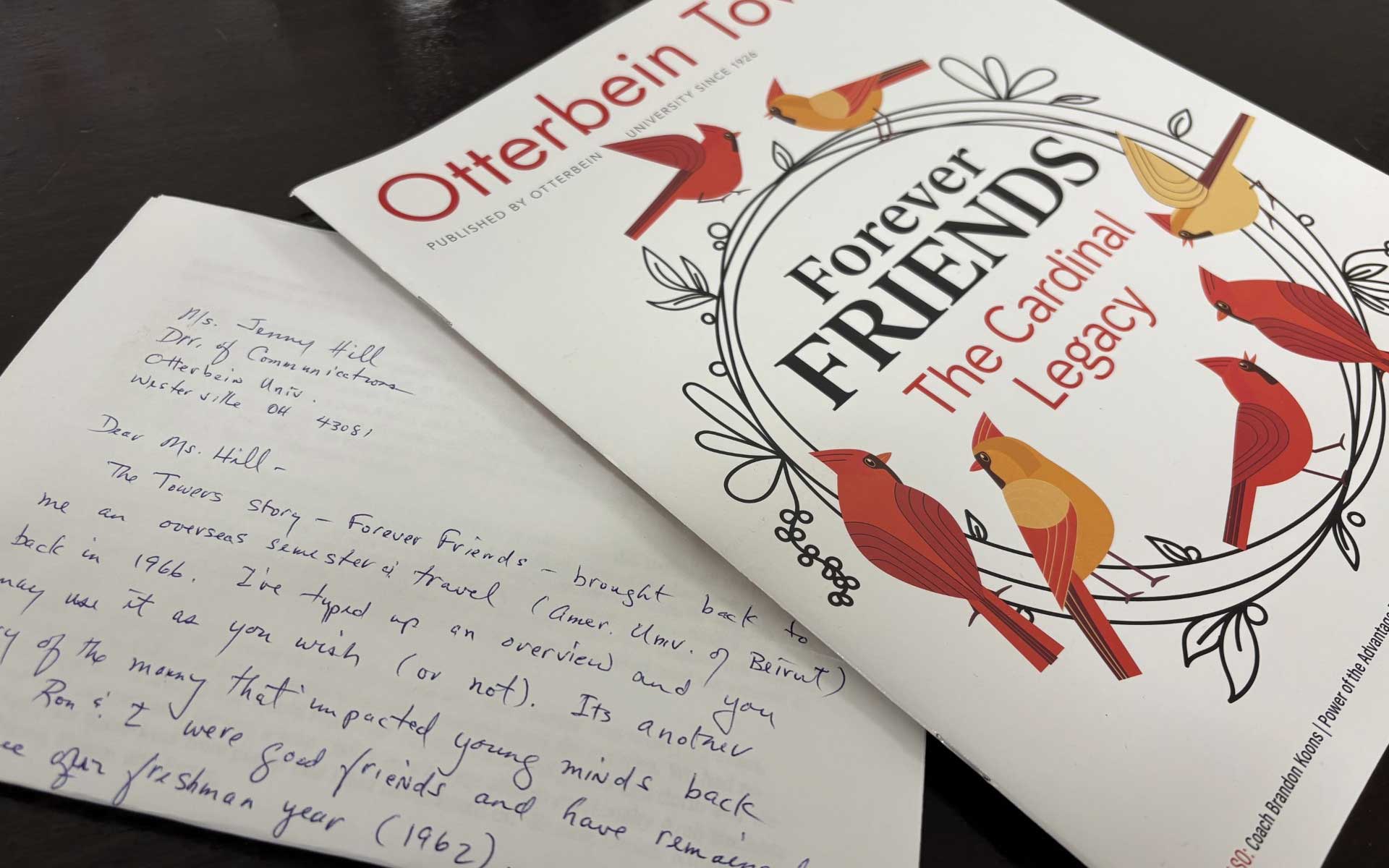
In response to the “Forever Friends” story in the Spring 2025 issue of Towers, Gail Miller ’66 shared his own story of friendship and travel with Ron Orbin ’66.

People often comment about the trip of a lifetime and how it still resonates with them. Of course, it takes a lifetime to sift through the experiences and come up with the most memorable.

Sixty years ago, as I started my senior year, I thought about studying abroad. Perhaps it was a bit late, and I wasn’t fluent in any foreign language, but I wanted to see more than Ohio. Somewhere I read about the American University of Beirut (AUB) in Lebanon, and as a History major, the Mediterranean was intriguing. Surprisingly the Registrar’s Office had (AUB’s) Academic Catalog. As an accredited university, the language of instruction was both Arabic and English. Drawing its several thousand students (and faculty) from the Middle East, Egypt, Europe, Asia, and a few from the U.S., English was the primary common language. Pete Baker, the registrar, assured me the courses would transfer and I would have the credit hours needed for Otterbein’s degree.

I convinced a close friend, Ron Orbin (also a senior), that we needed to do this before all the pressures of life after graduation would snare us. He jumped aboard and with the two of us, that gave our parents a little more assurance that we would manage this. Our applications as special students were accepted, and we made our travel plans for (AUB’s) spring semester starting in late January. Our (Otterbein) advisors, mine in History, and Ron’s in Chemistry supported our plans and were flexible in how our coursework would satisfy any remaining requirements because we had no idea what would be offered until we arrived at AUB.

In 1966, Beirut was a bustling city of many different nationalities. The country was relatively calm, prosperous, and confident about its future, unlike what has happened since the ’80s. We had no trouble getting registered in classes that would finish our majors. We found places in a dorm and we both had Palestinian roommates. That was a wise choice as we were able to meet many Arab students and other nationalities. Some were from places that I had never heard of: Yemen, Oman, Kuwait, and many from Lebanon, France, and Egypt.

There were about two dozen undergrads who were “Americans,” but their parents were ex-pats working in the Middle East and many had never lived much in the U.S. that they remembered. We became close to many of them and they wanted to know what life was like back in the states! In many ways they were Americans who weren’t. Knowing them allowed for travel to Egypt, Syria, Jerusalem (then part of Jordan), and Athens. In most ways the college experience was similar to Otterbein. Classes, studying for tests, cafeteria, some sports, and hanging out in the evenings at some restaurants on Rue Bliss outside the university walls.

My roommate was a senior majoring in English and planning to return to the West Bank to teach in a high school. Others were studying to enter med school in Egypt or Lebanon. We learned a lot about their lives, and they, about ours. They couldn’t understand why we were at war in South Vietnam, and many of the other newsworthy problems in the U.S. in 1966. As for the political situation with Israel, even though they knew the U.S. supported that country, they believed there would be a fair resolution brokered by the U.S. for the displaced Palestinians.

Sixty years have distilled the memories, but the muezzin’s calls to prayer, the smell of street food, the interesting classes, and the casual pace of campus life remain. Yes, there were times that were boring, classes were hard, and we would miss home and Otterbein. But every day brought some new experiences and acquaintances; or figuring out what the cafeteria was serving!

Both of us would agree that the spring break week in Egypt was one of the most memorable. We visited the massive Egyptian Museum with many of the embalmed royalty, several pyramid sites, swam in the Red Sea, explored the completely unguarded antiquities at Saqqara, rode camels, and experienced the “Pharaoh’s revenge” offered free to all tourists.

The last few weeks of classes were bittersweet, knowing that we would be leaving those we had befriended, but with new confidence from living in a different culture and actually gaining 20 pounds! We had tickets to return to the U.S. from Frankfurt in five weeks, so the next chapters were drawn from (the book), “Europe on 5 Dollars A Day.” At that time, backpacking around Europe was the new summer activity for American and Canadian college students and that paperback was the blueprint.

Ron had to remain in Beirut for a few weeks, having an illness that delayed his finals. He insisted I go, and we agreed to meet at a specific location in Brussels in three weeks. Traveling alone through Syria and Turkey was a unique experience, trying to get to Istanbul without a hint of the language or route. Here the travel had to be negotiated, particularly getting across the closed border between Turkey and Syria, engaged in some dispute over territory or rebel groups. Istanbul was a two- or three-day journey by bus, and with the kindness of Turks (using sign language), I made it.

Three or four days were spent in each city that I wanted to visit on the way to Brussels. Istanbul was truly fascinating, Athens also. The trip through Yugoslavia was a throwback in time, stuck on an old steam and coal powered train for two days. Americans were not allowed to leave the train without visas. Munich offered the Hofbräuhaus beer hall and raucous evenings. Amsterdam had museums, canals, and lots of college students, some from behind the Iron Curtain. In all the cities, others on the same journey would get together to compare notes and experiences. Staying mostly in student hotels, it was easy to find others to visit the sites, find food, and hang out. It was a time when the U.S. dollar was very strong and $5 a day would work.

Ron and I met as planned and started our second journey through France, Madrid, Barcelona, and to Frankfort. We had the name of a friend while in Beirut who was to be in Brussels that summer, and when we visited his address, we had a fortunate surprise. He was elsewhere, but it was some Evangelical commune, and they needed someone to drive an old VW bus loaded with Bibles to various places in France and Spain. Running a bit short of money, they gave us some dollars and the keys. We took our time, sleeping in the van and finding our way through France.

One of the memorable overnights was at a small youth hostel deep in the picturesque Pyrenees, where the keeper was an American doctoral student at the University of North Carolina! He warned us not to go out of the enclosure at night as there were smugglers’ mule trains moving through the mountains to trade in either Spain or France.

Spain was very backward, with their dictatorship limiting economic growth, but Madrid was alive and busy. After a few days we made our way by bus to Frankfurt a day or two before our flight. While there, in a coffee shop, a juke box was playing an unusual song — “Monday, Monday” by the Mamas & the Papas. Not having heard American music for six months, it now is an indelible memory that takes me back whenever I hear it.

Now in 2025, seeing travel advertising that shows the Great Pyramids of Giza, the Sphinx, the Acropolis, Al-Aqsa and the Blue Mosque, and many of the famous paintings in European museums, reinforces the inner voice that says, “you did it and your dream of travel become a reality.”

And that’s the message to Otterbein students today: challenge yourselves, get beyond Ohio, move beyond your fears and connect with people. The college will support your studies because there’s a world of learning out there with rewards well beyond what you could imagine!

Ron is now a retired physician in Arizona, and I’m a retired college professor living in Pennsylvania. We see each other often and talk regularly. It’s an Otterbein friendship for over 60 years and counting.

Send us your Forever Friends story! You can email your story to Jenny Hill at jhill@otterbein.edu or mail your story to: Jenny Hill, Office of Marketing and Communications, Otterbein University, 1 S. Grove St., Westerville, OH 43081.