Gail Miller ’66 Shares His “Forever Friends” Story
In response to the “Forever Friends” story in the Spring 2025 issue of Towers, Gail Miller ’66 shared his own story of friendship and travel with Ron Orbin ’66.
People often comment about the trip of a lifetime and how it still resonates with them. Of course, it takes a lifetime to sift through the experiences and come up with the most memorable.
Sixty years ago, as I started my senior year, I thought about studying abroad. Perhaps it was a bit late, and I wasn’t fluent in any foreign language, but I wanted to see more than Ohio. Somewhere I read about the American University of Beirut (AUB) in Lebanon, and as a History major, the Mediterranean was intriguing. Surprisingly the Registrar’s Office had (AUB’s) Academic Catalog. As an accredited university, the language of instruction was both Arabic and English. Drawing its several thousand students (and faculty) from the Middle East, Egypt, Europe, Asia, and a few from the U.S., English was the primary common language. Pete Baker, the registrar, assured me the courses would transfer and I would have the credit hours needed for Otterbein’s degree.
I convinced a close friend, Ron Orbin (also a senior), that we needed to do this before all the pressures of life after graduation would snare us. He jumped aboard and with the two of us, that gave our parents a little more assurance that we would manage this. Our applications as special students were accepted, and we made our travel plans for (AUB’s) spring semester starting in late January. Our (Otterbein) advisors, mine in History, and Ron’s in Chemistry supported our plans and were flexible in how our coursework would satisfy any remaining requirements because we had no idea what would be offered until we arrived at AUB.
In 1966, Beirut was a bustling city of many different nationalities. The country was relatively calm, prosperous, and confident about its future, unlike what has happened since the ’80s. We had no trouble getting registered in classes that would finish our majors. We found places in a dorm and we both had Palestinian roommates. That was a wise choice as we were able to meet many Arab students and other nationalities. Some were from places that I had never heard of: Yemen, Oman, Kuwait, and many from Lebanon, France, and Egypt.
There were about two dozen undergrads who were “Americans,” but their parents were ex-pats working in the Middle East and many had never lived much in the U.S. that they remembered. We became close to many of them and they wanted to know what life was like back in the states! In many ways they were Americans who weren’t. Knowing them allowed for travel to Egypt, Syria, Jerusalem (then part of Jordan), and Athens. In most ways the college experience was similar to Otterbein. Classes, studying for tests, cafeteria, some sports, and hanging out in the evenings at some restaurants on Rue Bliss outside the university walls.
My roommate was a senior majoring in English and planning to return to the West Bank to teach in a high school. Others were studying to enter med school in Egypt or Lebanon. We learned a lot about their lives, and they, about ours. They couldn’t understand why we were at war in South Vietnam, and many of the other newsworthy problems in the U.S. in 1966. As for the political situation with Israel, even though they knew the U.S. supported that country, they believed there would be a fair resolution brokered by the U.S. for the displaced Palestinians.
Sixty years have distilled the memories, but the muezzin’s calls to prayer, the smell of street food, the interesting classes, and the casual pace of campus life remain. Yes, there were times that were boring, classes were hard, and we would miss home and Otterbein. But every day brought some new experiences and acquaintances; or figuring out what the cafeteria was serving!
Both of us would agree that the spring break week in Egypt was one of the most memorable. We visited the massive Egyptian Museum with many of the embalmed royalty, several pyramid sites, swam in the Red Sea, explored the completely unguarded antiquities at Saqqara, rode camels, and experienced the “Pharaoh’s revenge” offered free to all tourists.
The last few weeks of classes were bittersweet, knowing that we would be leaving those we had befriended, but with new confidence from living in a different culture and actually gaining 20 pounds! We had tickets to return to the U.S. from Frankfurt in five weeks, so the next chapters were drawn from (the book), “Europe on 5 Dollars A Day.” At that time, backpacking around Europe was the new summer activity for American and Canadian college students and that paperback was the blueprint.
Ron had to remain in Beirut for a few weeks, having an illness that delayed his finals. He insisted I go, and we agreed to meet at a specific location in Brussels in three weeks. Traveling alone through Syria and Turkey was a unique experience, trying to get to Istanbul without a hint of the language or route. Here the travel had to be negotiated, particularly getting across the closed border between Turkey and Syria, engaged in some dispute over territory or rebel groups. Istanbul was a two- or three-day journey by bus, and with the kindness of Turks (using sign language), I made it.
Three or four days were spent in each city that I wanted to visit on the way to Brussels. Istanbul was truly fascinating, Athens also. The trip through Yugoslavia was a throwback in time, stuck on an old steam and coal powered train for two days. Americans were not allowed to leave the train without visas. Munich offered the Hofbräuhaus beer hall and raucous evenings. Amsterdam had museums, canals, and lots of college students, some from behind the Iron Curtain. In all the cities, others on the same journey would get together to compare notes and experiences. Staying mostly in student hotels, it was easy to find others to visit the sites, find food, and hang out. It was a time when the U.S. dollar was very strong and $5 a day would work.
Ron and I met as planned and started our second journey through France, Madrid, Barcelona, and to Frankfort. We had the name of a friend while in Beirut who was to be in Brussels that summer, and when we visited his address, we had a fortunate surprise. He was elsewhere, but it was some Evangelical commune, and they needed someone to drive an old VW bus loaded with Bibles to various places in France and Spain. Running a bit short of money, they gave us some dollars and the keys. We took our time, sleeping in the van and finding our way through France.
One of the memorable overnights was at a small youth hostel deep in the picturesque Pyrenees, where the keeper was an American doctoral student at the University of North Carolina! He warned us not to go out of the enclosure at night as there were smugglers’ mule trains moving through the mountains to trade in either Spain or France.
Spain was very backward, with their dictatorship limiting economic growth, but Madrid was alive and busy. After a few days we made our way by bus to Frankfurt a day or two before our flight. While there, in a coffee shop, a juke box was playing an unusual song — “Monday, Monday” by the Mamas & the Papas. Not having heard American music for six months, it now is an indelible memory that takes me back whenever I hear it.
Now in 2025, seeing travel advertising that shows the Great Pyramids of Giza, the Sphinx, the Acropolis, Al-Aqsa and the Blue Mosque, and many of the famous paintings in European museums, reinforces the inner voice that says, “you did it and your dream of travel become a reality.”
And that’s the message to Otterbein students today: challenge yourselves, get beyond Ohio, move beyond your fears and connect with people. The college will support your studies because there’s a world of learning out there with rewards well beyond what you could imagine!
Ron is now a retired physician in Arizona, and I’m a retired college professor living in Pennsylvania. We see each other often and talk regularly. It’s an Otterbein friendship for over 60 years and counting.
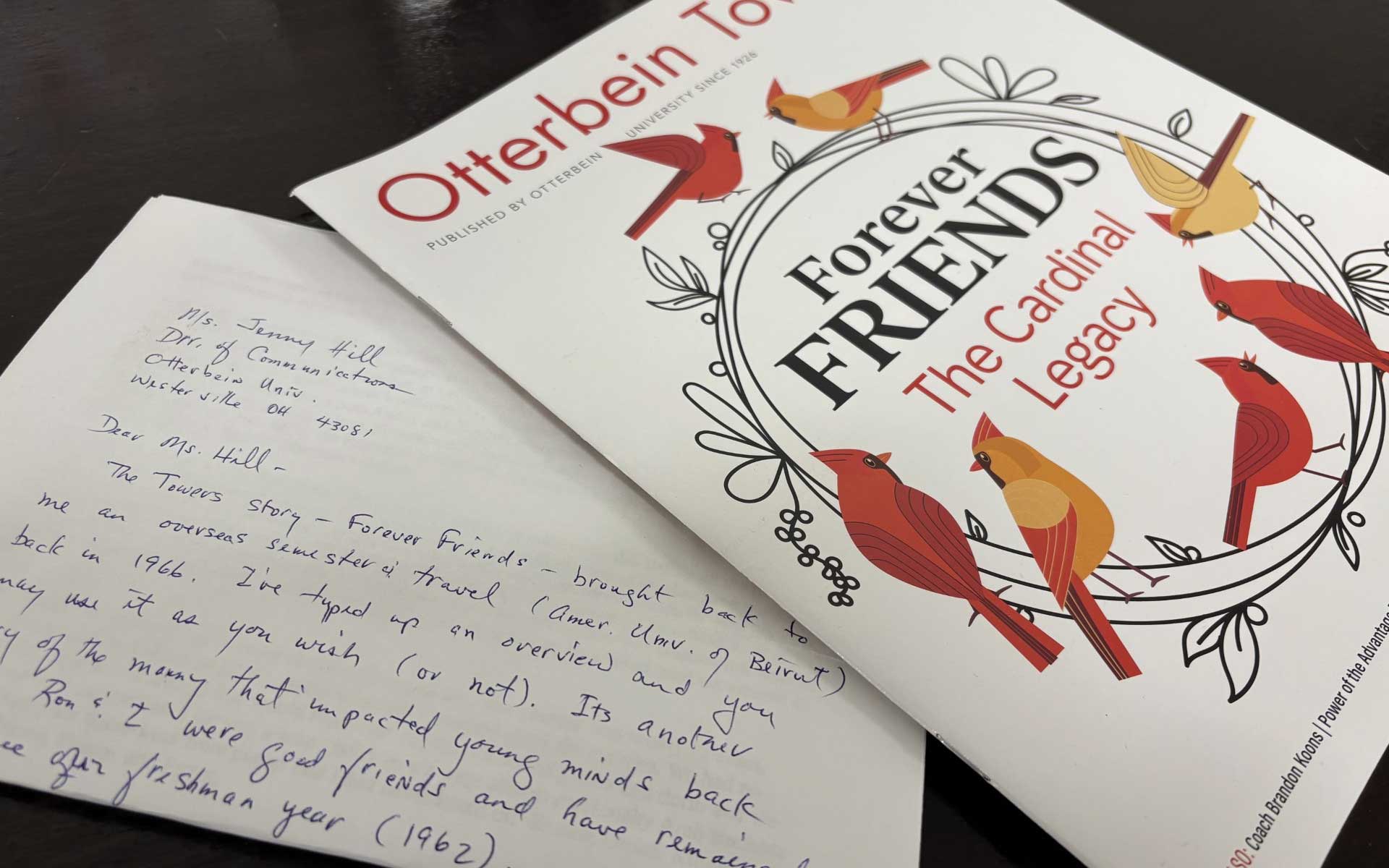
Send us your Forever Friends story! You can email your story to Jenny Hill at jhill@otterbein.edu or mail your story to: Jenny Hill, Office of Marketing and Communications, Otterbein University, 1 S. Grove St., Westerville, OH 43081.