Faculty Members Recognized for Teaching Excellence

Mary B. Thomas Award Honorees 2022

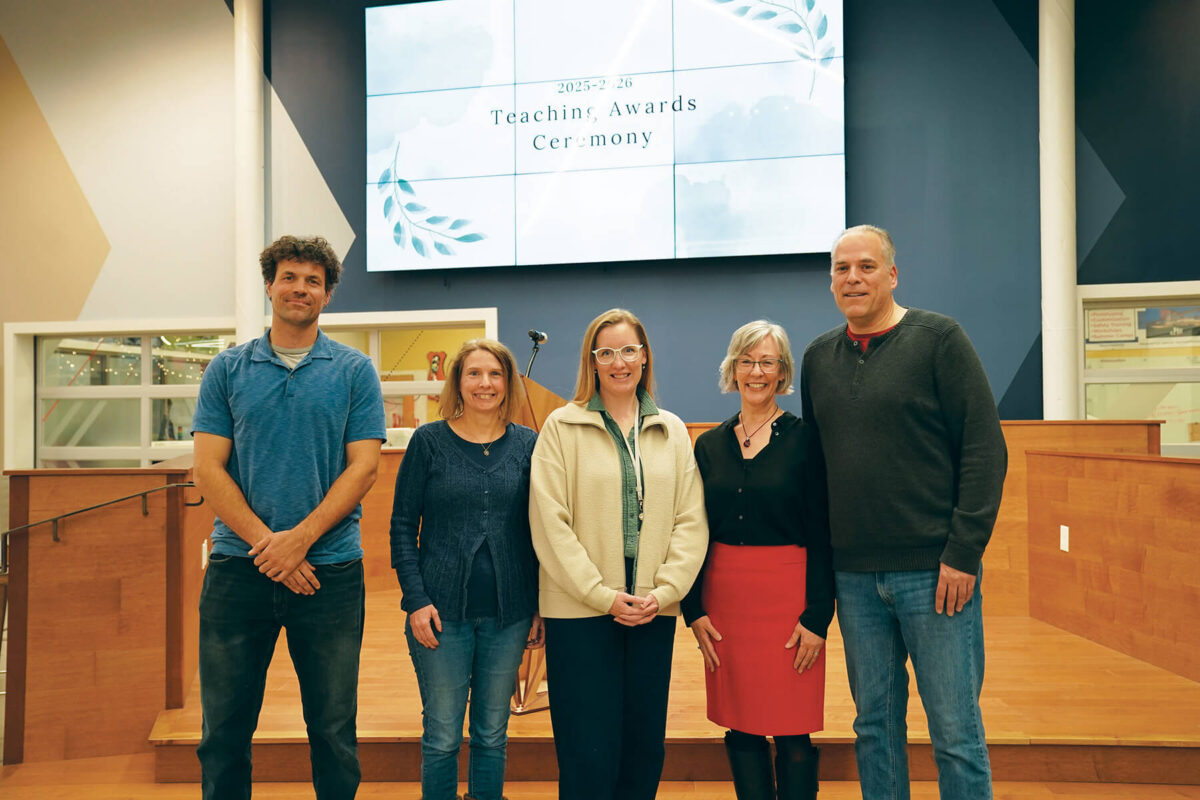
L to R: Alex Fotis, Michele Acker, Laine Schrewe, Provost Wendy Sherman Heckler, and Paul Eisenstein.

On Nov. 21, 2025, Otterbein honored outstanding teachers for their impact on their students, colleagues, and the University.

This year’s award winners are:

This year’s award winners are:

New Teacher of the Year
Laine Schrewe
Assistant Professor, Department of Engineering

Teacher of the Year
Paul Eisenstein
Professor, Department of English

Reynolds Exemplary Teaching Award
Michele Acker
Professor, Department of Psychology

Excellence in Teaching (Part-time)
Alex Fotis
Integrative Studies
An Otterbein Legacy for Life

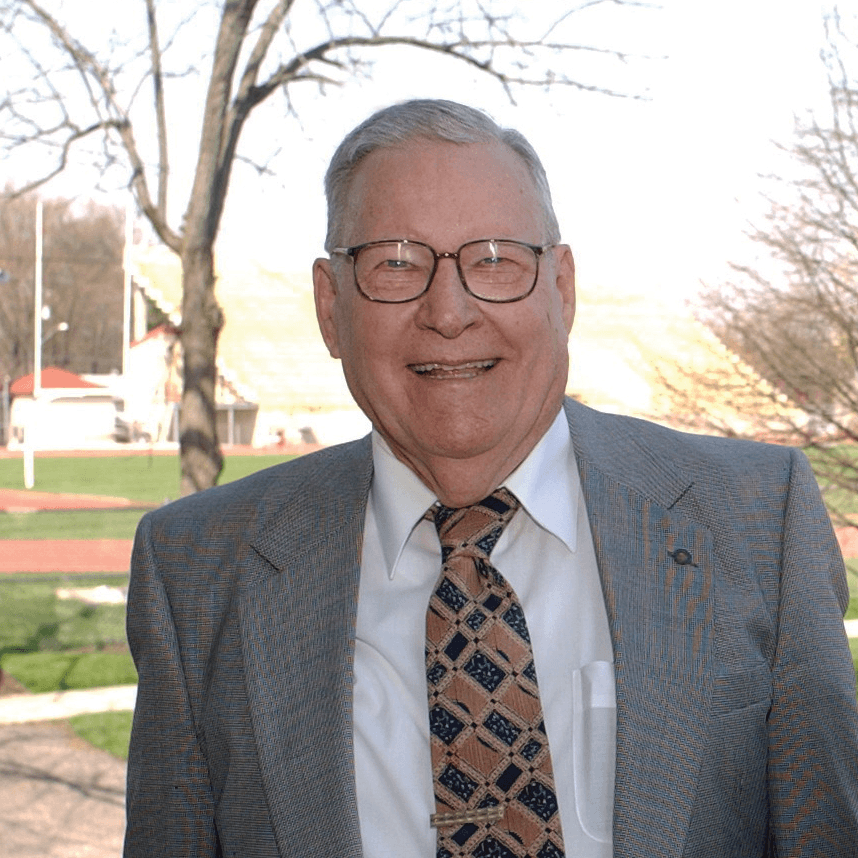
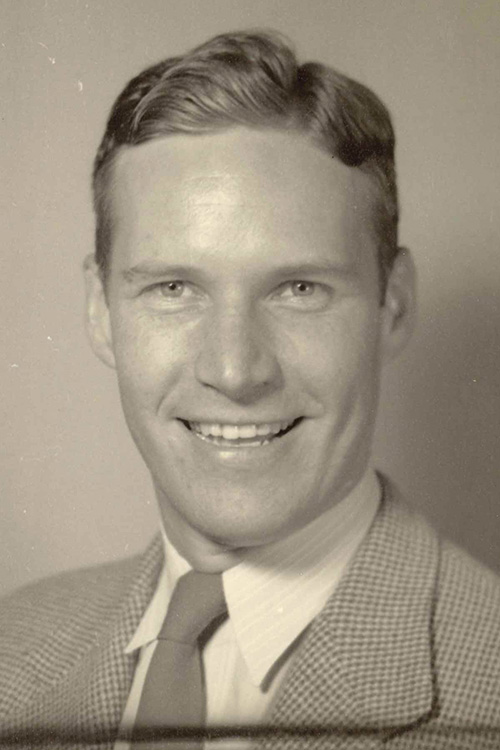
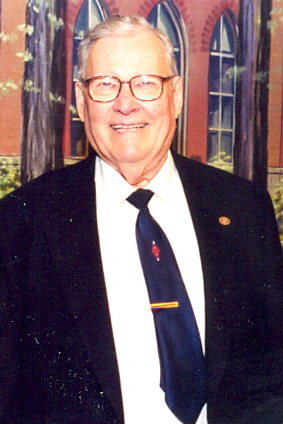
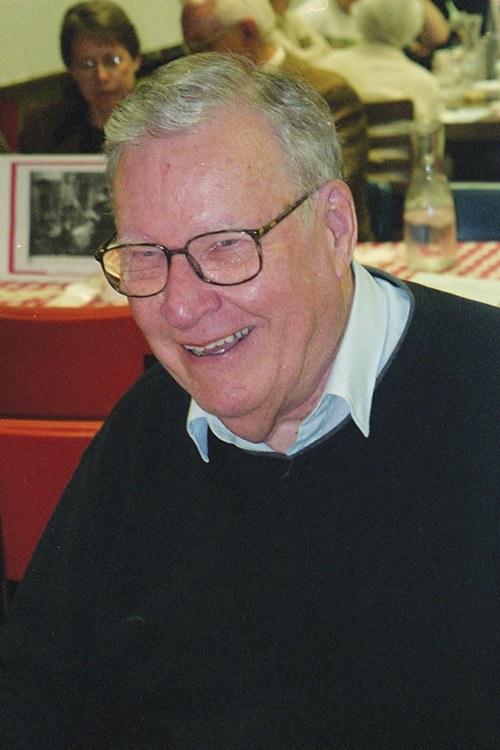
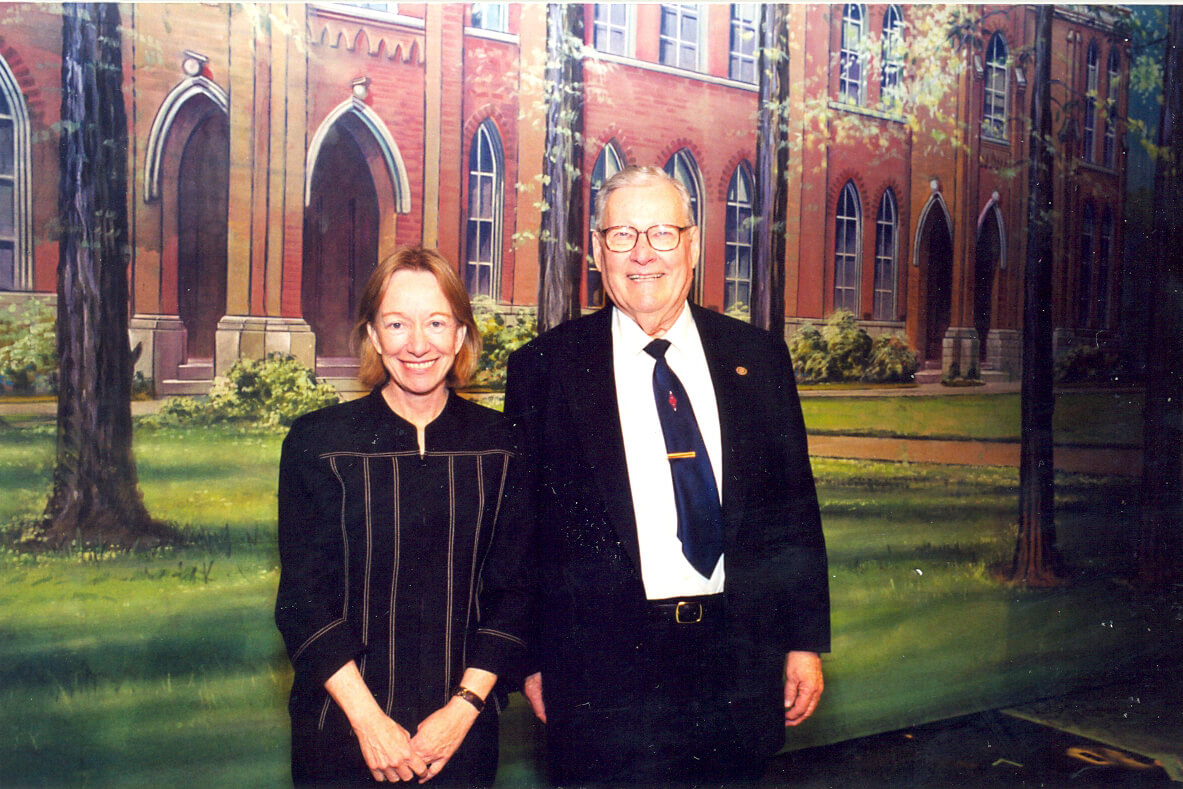
Vernon L. Pack ’50

An Otterbein Legacy for Life

Pack $5.2 Million Estate Gift Among Largest University Individual Gifts
Over the years, Vernon L. Pack ’50 is recognized as one of Otterbein’s most faithful and generous alumni champions.

The visionary philanthropist created the Pack Lecture and the Pack Visiting Scholar programs bringing some of the most compelling and thought-provoking scholars and leaders to campus for more than two decades. He also enriched student research and community engagement by funding the Vernon L. Pack Fellowship program and regularly supported the Otterbein Fund, the Promise House, the Courtright Memorial Library, scholarships, awards, and numerous academic and student affairs programs and initiatives.

Otterbein is now humbled to announce that Vernon’s remarkable legacy of generosity continues with the recent receipt of one of the largest individual gifts in the University’s history — a $5.2 million dollar estate gift — bequeathed to his alma mater upon his passing.

To know this remarkable Cardinal philanthropist was to know a gentle, intelligent, and passionate leader who was thoughtful and measured in the ways he chose to support his treasured Otterbein. His gifts always sought to advance learning, to further the common good, and to help Otterbein University grow in its offerings, service, and reputation. With deep respect for the programs and initiatives Vernon held dear, the University will thoughtfully explore the most meaningful ways to honor his legacy, ensuring his gift continues to uplift Otterbein and shape its future.


Vernon L. Pack ’50
Vernon L. Pack ’50
Vernon L. Pack ’50

CELEBRATING A LANDMARK GIFT TO OTTERBEIN

Summer Campus Reunion

Julie Russell Summer Reunion Group Picture

Left to Right: Mary Yarbrough ’93, Bill Yarbrough ’94, Tom Cardinal ’92, Katy Wyatt ’92, Melissa Barber ’92, Kelly Fleming ’92, Chris Sanford ’92, and Julie Cremean Russell ’92.

Julie Cremean Russell ’92 organized a reunion of friends in summer 2025 after an Otterbein friend passed away. A goal of their visit was to share their love of singing together once again on a stage at Otterbein. The group sang The Otterbein Love Song on the stage of Riley Auditorium at the Battelle Fine Arts Center.

Watch the video of their impromptu performance at www.tinyurl.com/OtterBLove.


Academic Excellence Spring 2026

Art Professor Jonathan Johnson was invited to present his artwork at the 14th annual conference at the American University of Florence, Italy. The theme was The Renaissance of Material Media, and Johnson’s presentation was Spells Against Acceleration: Embodied Filmmaking and the Poetics of Super 8mm Film.

Senior Public Health major Hanan Jama, was named Undergraduate Student of the Year by the Ohio Society for Public Health Education. Jama is an undergraduate research fellow at the Chisolm Lab at the Center of Child Health Equity and Outcomes Research at Nationwide Children’s Hospital. At Otterbein, Jama is the recipient of the Fred J. and Ann P. Kull Scholarship and the Daniel C. Thompson Memorial Scholarship.

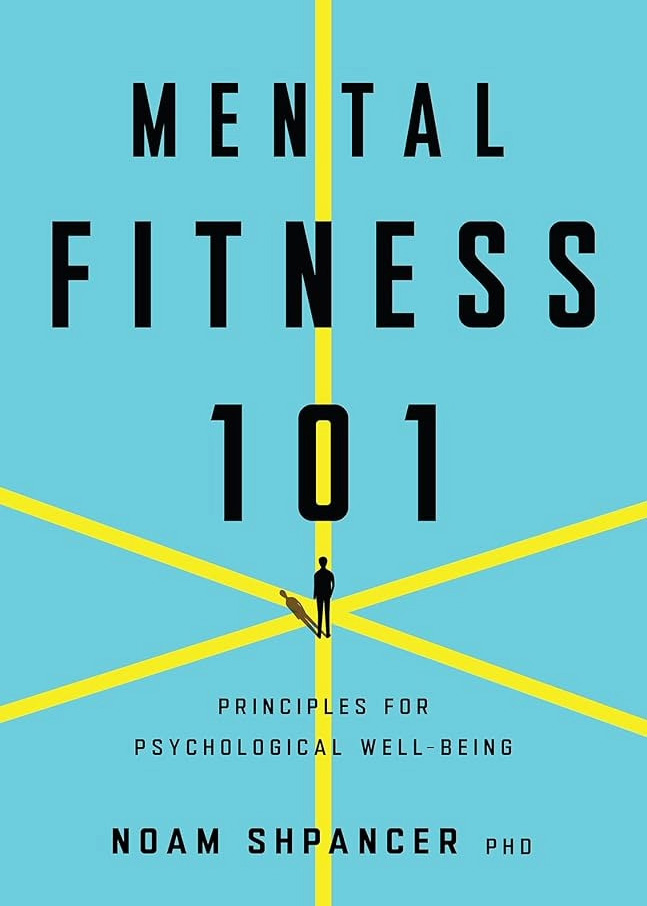
Psychology Professor Noam Shpancer, has published Mental Fitness 101: Principles for Psychological Well-Being.

Professor John Tansey, chair of the Chemistry Department, has been elected to the American Society for Biochemistry and Molecular Biology (ASBMB) Council. The ASBMB has over 11,000 members, publishes four scientific journals, and accredits Biochemistry and Molecular Biology programs like Otterbein’s. He joins eight other councilors who are faculty at institutions like Harvard Medical School, Stanford University, and Massachusetts Institute of Technology.

New Alumni Database Coming in 2026

Otterbein is launching a new alumni database in 2026 with enhanced functionality designed to make it easier for the University’s more than 29,000 alumni to stay connected to Otterbein and each other. Otterbein needs the help of its alumni to ensure the database has the most up-to-date and accurate information possible, including:

  • Career and job changes (new jobs and retirements)
  • Advanced degrees earned
  • Address updates (mailing and email)
  • Phone updates (home and cell)
  • Weddings and births/adoptions
  • Books or research published
  • Any other exciting milestones or achievements

Alumni can update their information at: www.otterbein.edu/alumni/update-my-information.

Stay Informed and Connected to the Cardinal Community

One of the best ways to stay informed about alumni events and offerings is to connect with Otterbein on social media. Follow Otterbein Alumni on social media for inspiring stories, upcoming events, and the latest ways to engage, give back, and celebrate all things Otterbein.

The Office of Alumni Engagement regularly features social media posts that will take you on a trip down memory lane, recognize alumni accomplishments, and share how Cardinals are making an impact around the world.

Visit, follow, or like Otterbein Alumni on Facebook, Instagram, and LinkedIn.

Chapters Of Our Story From The Pages of Towers

Chapters Of Our Story

From The Pages of Towers

There are a lot of things one can learn about Otterbein’s story by reading old issues of Towers. What were the University’s priorities? How were academics and the face of campus changing? This is a glimpse of some of the highlights — you can explore more in these issues and others.

1930s: The Great Depression impacted finances.

October 1931 “Along with many other colleges, Otterbein suffered a drop in her Freshman Class.”

October 1931 Homecoming game vs. Capital, Oct. 17, 1931. “Capital beat the Big Tan Team last year and our boys are out this year to reverse the score. Polish up Dobbin’s harness, grease the old buggy, get Sally and the children in and be here for the Big Day.”

August 1932 A letter from President Walter G. Clippinger read, in part, “There are fifty-five young people on our list of prospects who cannot come to Otterbein or any other college without special help. It will take $5,000 in gifts and loans to bring them here.”

December 1935 Students led a trial run for co-ed dining. “Generally, the opinions concerning the innovation were quite favorable, many stressing the fact that it was not only good social training but also an excellent opportunity for them to become better acquainted with their school colleagues.”

September 1939 The freshman class enrollment was the largest since 1926-27; total enrollment was 418 students.

1940s: World War II defined campus life.

March 1946 A campaign was announced to build Memorial Stadium in honor of the 13 men and one woman from Otterbein who lost their lives serving in World War II.

December 1946 The 1946 football team, filled with veterans, had the most successful year in Otterbein history. “Otterbein enjoyed a perfect conference record and is the undisputed champion of the Ohio Conference.”

March 1948 The “OtterBarn” became the first student union. It was 5,000 square feet with a lounge, reading room, and snack bar. It was formerly a non-commissioned officers’ club at Camp Reynolds, PA.

March 1948 Otterbein’s WOBC radio station hit the airwaves. “Recorded and live music, campus news and sports, and chapel and church services will be heard on the daily broadcasts.”

1950s: Facilities and faculty fueled academic expansion.

March 1950 A feature on the Home Economics program claimed, “There is no art that contributes so much toward the happiness of mankind as the art of Fine Home Making.”

September 1951 Cowan Hall was built, thanks to a gift from Clyde E. Cowan, class of 1904.

December 1954 Schear Greenhouse was dedicated to Professor Edward Waldo Emerson Schear, who retired in 1951 after 39 years of service.

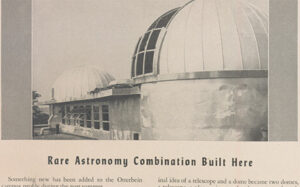
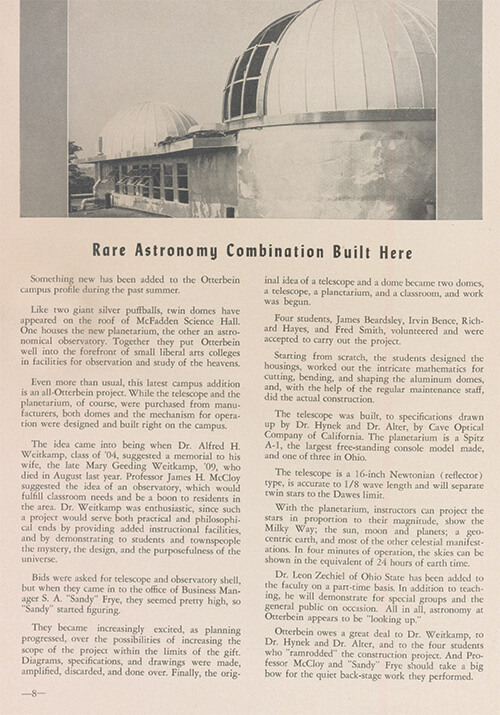
September 1955 Weitkamp Observatory was built. “Like two giant silver puffballs, twin domes have appeared on the roof of McFadden Science Hall. One houses the new planetarium, the other an astronomical observatory. Together they put Otterbein well into the forefront of small liberal arts colleges in facilities for observation and study of the heavens.”

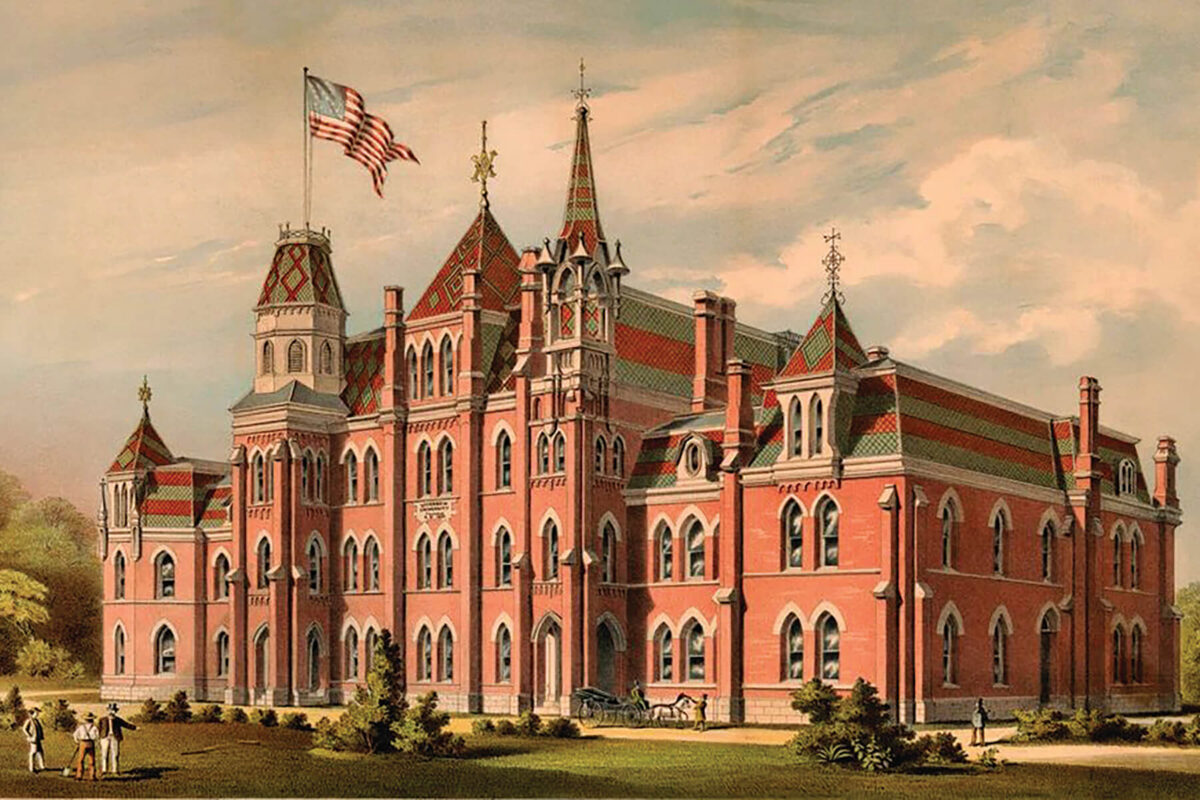
March 1956 There was a contest to name “Academic Hall,” formerly the “Administration Building.” In the June 1956 issue, it was announced that the building was renamed “Towers Hall.”

Professor LaVelle Rosselot revolutionized language learning by creating a French-language film series (May 1956 and January 1959), then established one of the first language laboratories (April 1959).

1960s: As global travel became easier, Otterbein’s worldview expanded.

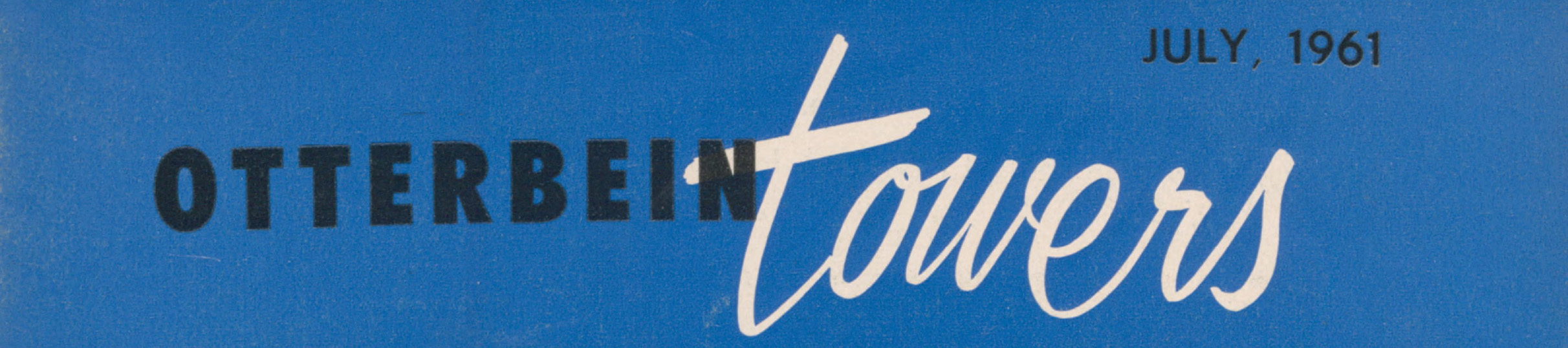
July 1961 Towers featured commencement speaker John Albert Musselman Karefa-Smart ’40, minister of external affairs and defense of Sierra Leone. (See cover on timeline page 8.) In October 1961, Towers reprinted an article about the event in The Chicago Sun-Times, “Contributions of a Small College”.

January 1964 The first study abroad class wrote about their time in Strasbourg, France.

Spring 1967 First Otterbein Summer Theatre season was announced.

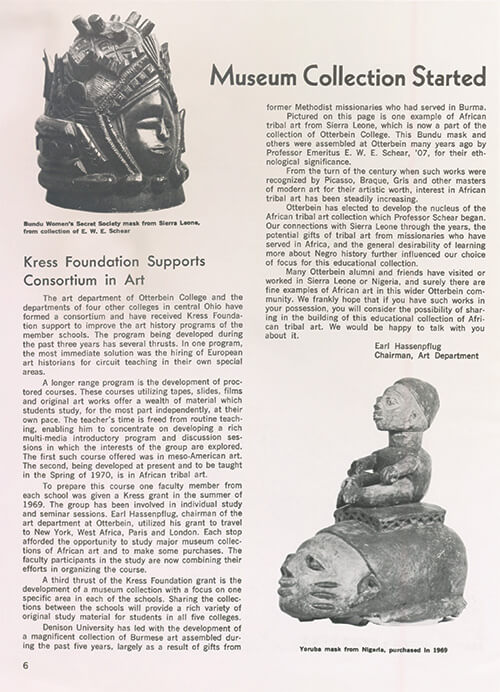
Summer 1969 Otterbein’s African art collection was officially established with a grant from the Kress Foundation.

1970s: Social movements spread on campus.

Spring 1970 Otterbein became the first university to add faculty and student members to the Board of Trustees. The New York Times covered the story, “Ohio College Puts Students on Board of Trustees”.

Winter 1970 The nation’s top consumer guardian, Ralph Nader, discussed environmental hazards at a campus convocation.

Spring 1971 The Board of Trustees allowed the creation of sorority houses on campus. By the Summer 1974 issue, Otterbein dropped the policy of setting women’s residence hall hours in favor of a card key system that allowed women to enter residence halls after “closing hours.”

Fall 1975 New academic programs include the adult degree program; bachelor’s programs in equine science and stable management (Summer 1976); bachelor of fine arts (BFA) in theatre (Spring 1977); and bachelor of science in nursing (Fall 1978).

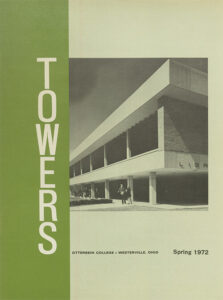
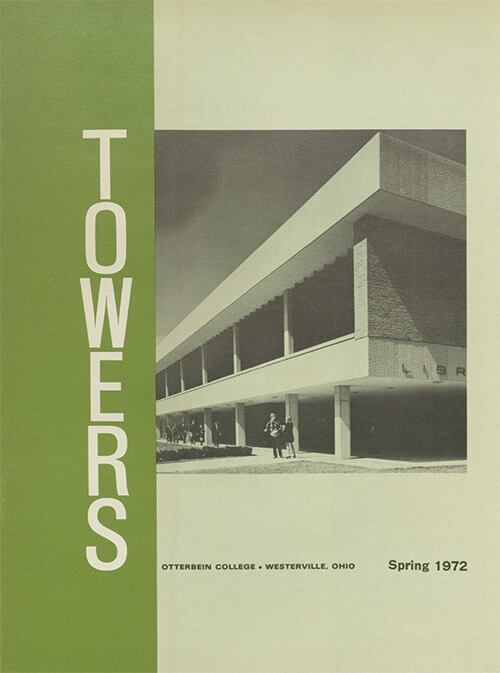
New building projects included Courtright Memorial Library (Spring 1972); Rike Center (Summer 1975); and Battelle Fine Arts Center (Spring 1979).

1980s: Pop culture and new programs gained popularity.

Spring 1982 “Otterbein College was featured as the location for Arthur Carlson’s 25th class reunion on… ‘WKRP in Cincinnati.’ The reunion show, entitled ‘You Can’t Go Out of Town Again,’ revolved around the return of station manager Carlson and his wife to Otterbein where they reminisced about the early days of their courtship. Gordon Jump ‘55, who plays Mr. Carlson, is an Otterbein alumnus.”

Winter 1983 The new equine riding team competed for the first time in the Intercollegiate Horse Show Association (IHSA). The team won its first national championship in its third year of competition.

Summer 1983 Joanne Van Sant choreographed her 29th musical. “Otterbein’s own triple threat, ‘Dean Van’ serves as vice president for student affairs and dean of students, as an associate professor of health and physical education, and as choreographer for Otterbein College Theatre and Otterbein Summer Theatre.”

Spring 1989 President C. Brent DeVore H’86 discussed new master of arts in education (MAE) and master of arts in teaching (MAT) programs.

1990s: Community outreach became a campus priority.

Otterbein established mentorship programs to encourage college attainment in underserved schools, including the Linmoor-Otterbein Scholars Program (Fall 1991) and the Indianola After-School Program (Spring 1998).

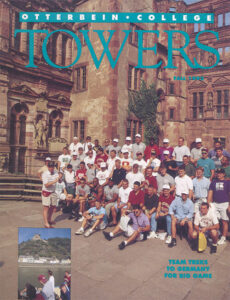
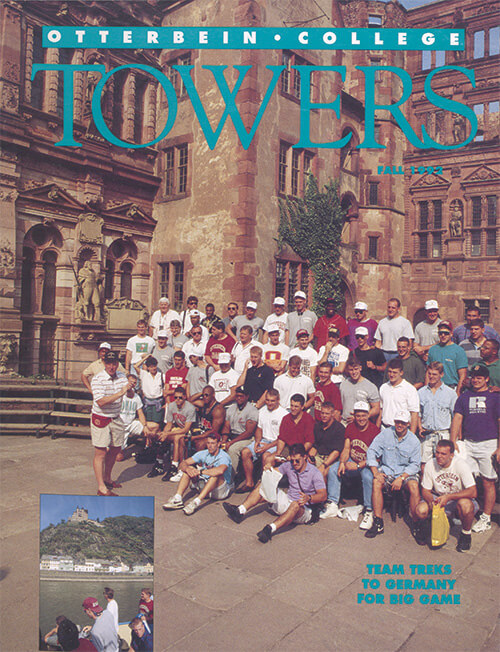
Fall 1992 Otterbein and Heidelberg University football teams traveled to Germany to play the “Rhine River Classic,” which ended in a 7-7 tie.

Summer 1993 The Edwin L. ’47 and Marilou ’45 Roush Hall was dedicated.

Fall 1993 The Fall Faculty Conference topic was “Integrating Service/ Community Learning into the Classroom.” By Winter 2009, there were 90 service-learning courses.

Summer 1995 Mary B. Thomas ‘28 endowed The Thomas Academic Excellence Series, or Common Book.

Winter 1997 Republican presidential candidate Bob Dole held a rally at the Rike Center on Oct. 22, 1996.

Winter 1999 They Might Be Giants performed at Otterbein on Jan. 29, 1999.

2000s: Advances in athletics and changes in leadership.

Spring 2000 The Vernon L. Pack ’50 Distinguished Lecture and Scholar-in-Residence Series was established.

Spring 2002 The men’s basketball team won the NCAA Division III National Championship under Head Coach Dick Reynolds ’65.

Winter 2003 Clements Recreation Center opened.

Fall 2008 The inaugural class was inducted into the Athletic Hall of Fame.

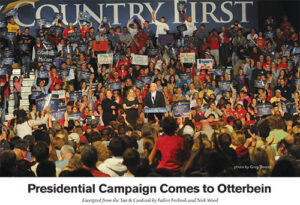
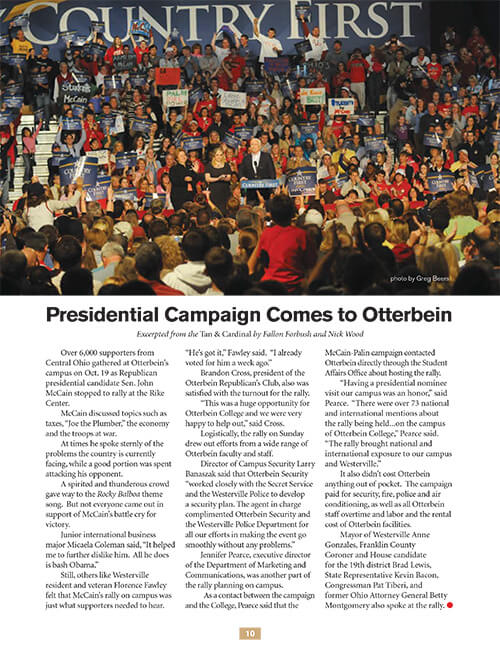
Fall 2008 Sen. John McCain held a rally at the Rike Center on Oct. 19, 2008.

Spring 2009 President C. Brent DeVore H’86 retired after 25 years.

Fall 2009 Otterbein’s first woman president, Kathy A. Krendl H’18, was inaugurated.

2010s: Creating programs for the future.

Spring 2010 Otterbein College became Otterbein University again.

Fall 2012 The Austin E. Knowlton Center for Equine Science was dedicated.

Spring 2013 First class of Zoo and Conservation Science began in the fall with practicum opportunities at the Columbus Zoo and the Ohio Wildlife Center.

Summer 2014 Systems Engineering major was launched.

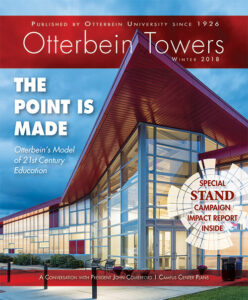
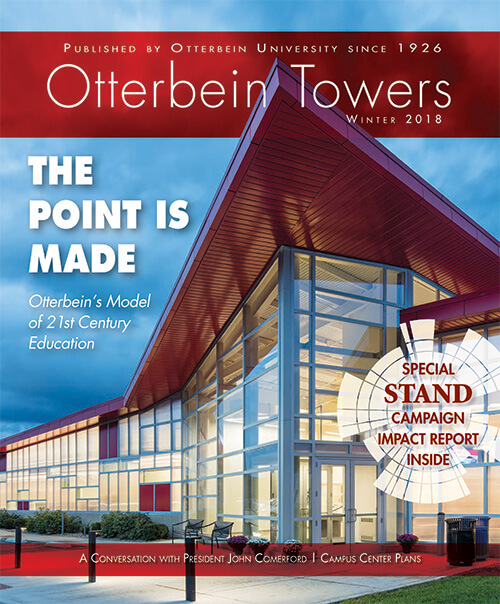
Fall 2016 The Point at Otterbein officially opened.

Spring 2018 President Emerita Kathy A. Krendl H’18 retired after nine years.

Winter 2018 The Where We Stand Matters campaign raised $52,775,000 from more than 10,000 donors.

Spring 2019 President John Comerford was inaugurated.

Fall/Winter 2019 CNN and The New York Times hosted the Democratic Presidential Primary Debate on campus in October 2019.

2020s: As for the 2020s, history is still being written.

Witness to History

THE SCOTTISH HISTORIAN AND PHILOSOPHER THOMAS CARLYLE ONCE SAID, “HISTORY IS THE ESSENCE OF INNUMERABLE BIOGRAPHIES.” SOME OF THOSE BIOGRAPHIES — THE STORIES AND EXPERIENCES OF OTTERBEIN STUDENTS, ALUMNI, FACULTY, AND STAFF WHO LIVED THROUGH HISTORICAL EVENTS — HAVE BEEN TOLD ON THE PAGES OF TOWERS THROUGH THE DECADES.

World War II

World War II

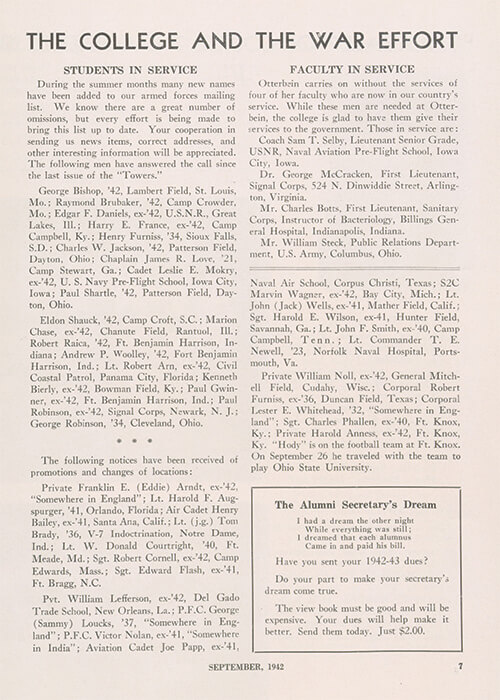
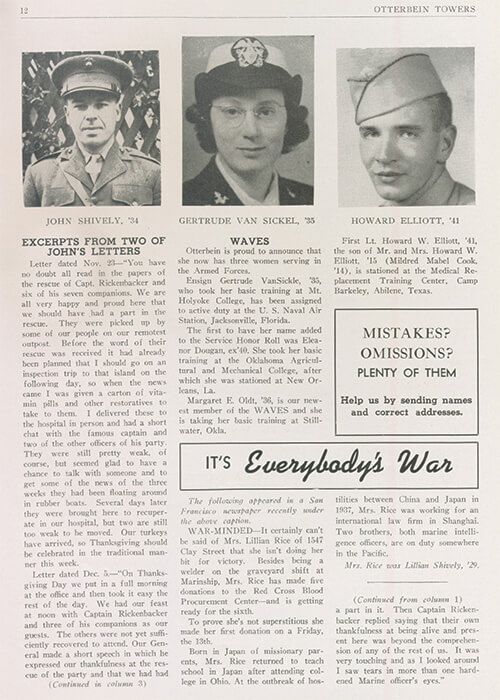
The first signs of World War II appeared in the September 1941 issue of Towers, with a list of 23 men called “In the Army Now.” The U.S. entered WWII in December 1941. Subsequent issues included news of Otterbein men and women serving in the military — from happy news of promotions and “furlough brides,” to sad news of those who were prisoners of war, missing in action, and killed in action.

In April 1942, in addition to the news that Sam Selby, the athletic director and head coach of football, basketball, and baseball, had been drafted to serve in the Navy, there was an “S.O.S. to All Alumni” about the enrollment and financial declines the college was facing due to the war.

March 1943

By March 1943, Otterbein had “given up six professors” and “sent forth 221 known graduates and students to the different branches of the service.”

Otterbein was operating classes year-round to accelerate programs for students in the reserve corps and offering courses necessary to the war effort, including radio, meteorology, pre-medical, and pre-engineering. Otterbein was also offering facilities, equipment, and teachers to the government for use in officer training programs.

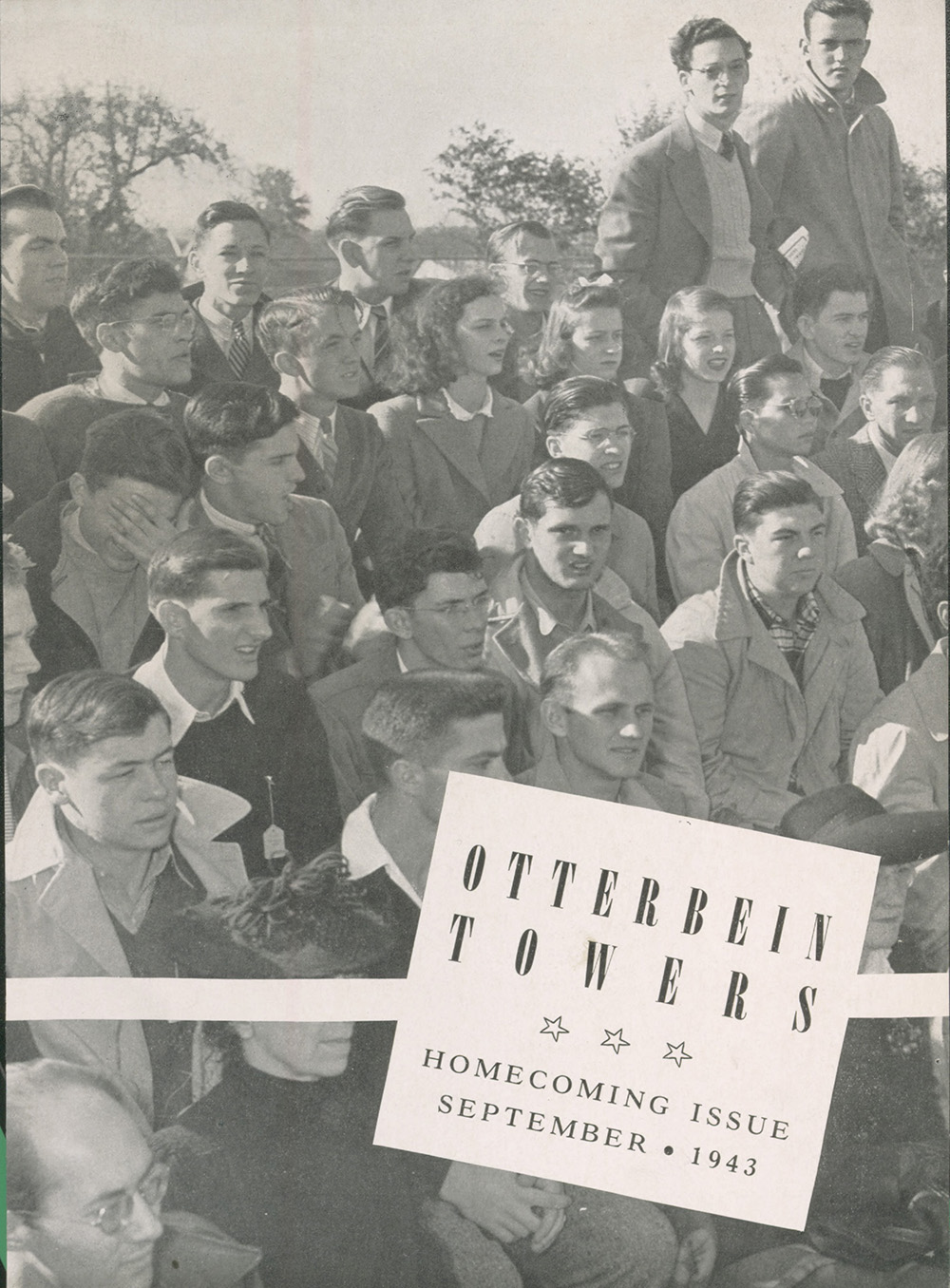
Starting with the September 1943 issue, Towers was sent to all service members with addresses on file, no matter where they were stationed, with the hope that news from home would lift their spirits.

Otterbein World War II Veterans

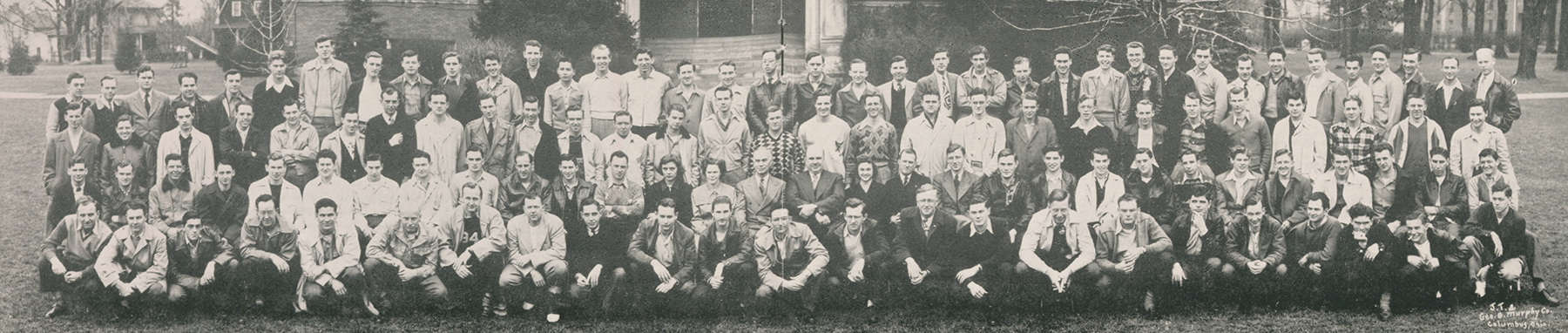
“…Some of the One Hundred Sixty Veterans Now Enrolled at Otterbein College” March 1946 Towers

When the war in Europe ended in May 1945 and in the Pacific later that year, American soldiers returned home in large numbers. The September 1945 issue chronicled the Homecoming celebrations that welcomed home the veterans, and later issues would list veterans who had returned to civilian life — and boast of record enrollment numbers.

In the same issue, a short article stood out from the rest: “We know of several Otterbein people who have worked on the production of the Atomic Bomb. There are probably many more. Since May 1943, Gilmore Crosby, ’43, has worked for the Eastman Kodak Company, first at Rochester, New York, and later at Oak Ridge, Tennessee, where he was a supervisor in the plant. Dr. John Flanagan, ’38, spent two years at the University of Chicago in research work and is continuing in Dayton at Monsanto Chemical Company. Allen Bartlett, ex’44, has for fifteen months been employed as a physicist at the New Mexico experimental base. We can all hope that the results of their labors may be for the benefit of humanity.”

Vietnam War

Vietnam War

During the Korean War years, Towers included a special news section for alumni who were serving in the military, but the Vietnam War mobilized students on campus as well as those serving overseas.

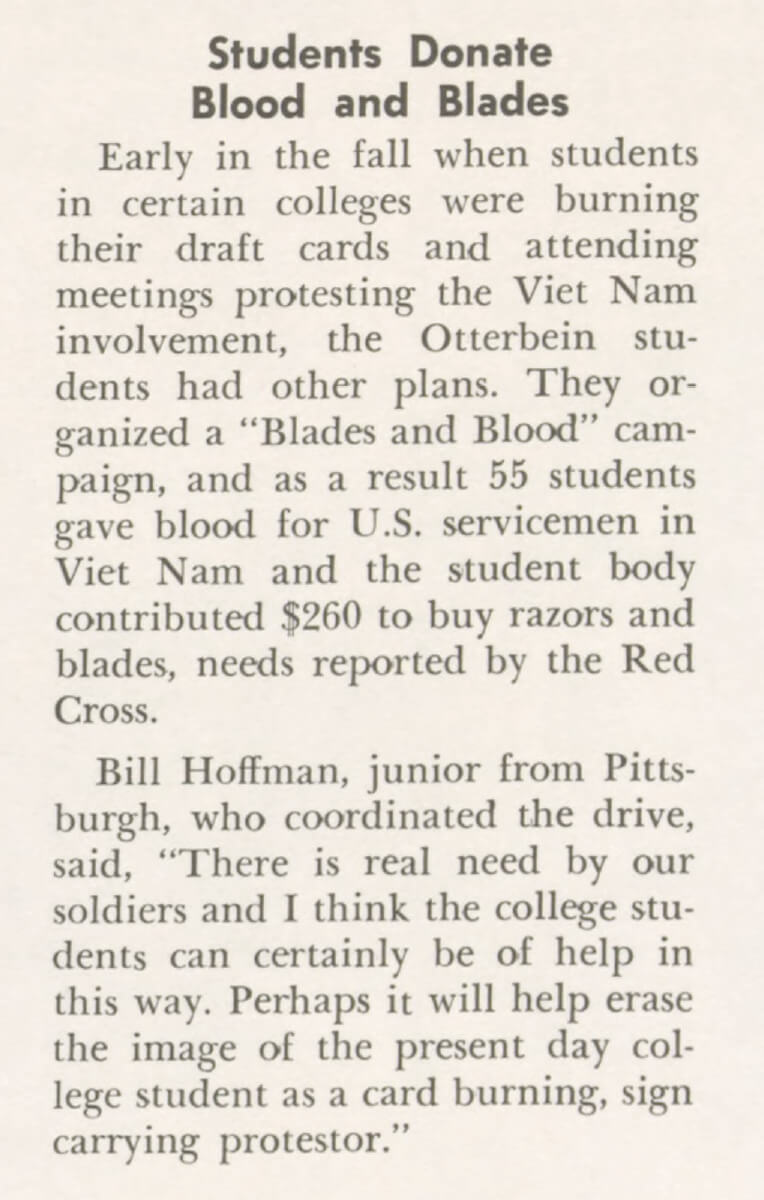
The January 1966 issue of Towers included an article about a “Blades and Blood” drive in which “55 students gave blood for U.S. servicemen in Viet Nam and the student body contributed $260 to buy razors and blades . . . .”

In Spring 1968, Towers reported on a book and toy drive by a student group called Angel Flight of Otterbein:

“The project began several months ago when Miss Nikki Katsilas (Schlonski ’71), sophomore from Pittsburgh, wrote to Major Robert Warner, 1956 graduate and navigator in the 16th Tactical Reconnaissance Squadron, South Vietnam, requesting permission for the Angel Flight to ‘adopt’ his outfit . . . In his letter of permission, Major Warner noted that, although the servicemen could use books, they were in need of toys for children at the Ky Quang Orphanage near Saigon, which the squadron was assisting.”

These stories of support countered the sad news of Otterbein alumni or students wounded or killed in action and, closer to campus, the tragedy at Kent State University.

Julie Russell Summer Reunion Group Picture

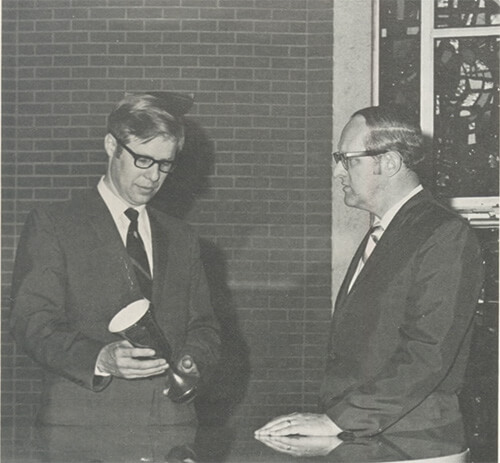
L-R: Rev. Duane Frayer ’53 was a Methodist minister who served Kent State students at the time of the shootings. Soon after, he handed his responsibilities to Rev. Donald Shilling ’54 .

On May 4, 1970, four unarmed college students were killed and nine wounded when the Ohio National Guard shot into a crowd of anti-war demonstrators at Kent State.

The shooting at Kent State was followed by a massive national student strike that shut down over 400 colleges and universities, but according to the Spring 1970 issue of Towers “a strike was avoided at Otterbein when the faculty passed an alternate proposal that all classes on Friday be devoted to talking about the war and other major national issues.”

Otterbein students shared opinions openly as a community, and anti-war students held a memorial service and organized a letter-writing campaign to Congress members and a peace march.

The Berlin Wall

The Berlin Wall

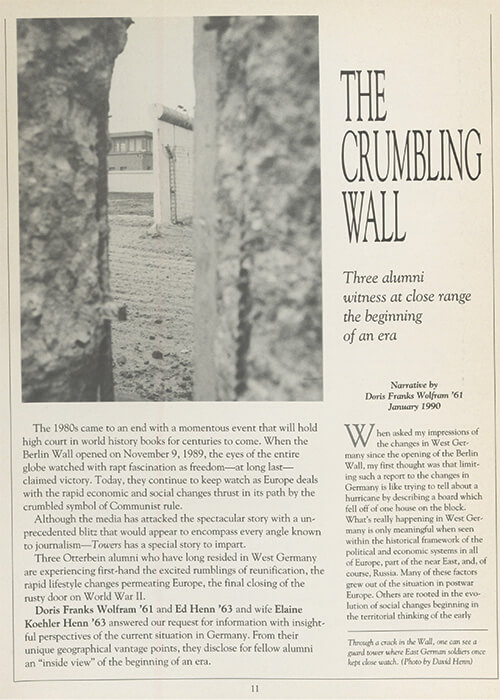
When the Berlin Wall “fell” on Nov. 9, 1989, the entire world celebrated. Three alumni were watching from a unique vantage point: West Germany.

Doris Franks Wolfram ’61 and Ed Henn ’63 and his wife, Elaine Koehler Henn ’63, shared their perspectives in essays in the Spring 1990 issue of Towers.

Wolfram shared, “Hardly any of (the East Germans) were really prepared for the overwhelming amount of various products available and the attractive and colorful packaging and advertising. One woman stood in the supermarket with her daughters and wanted to buy a bar of soap to take back. She picked up one brand of soap after another, smelled it, laid it back on the shelf and picked up the next and then the next. In the end she laid them all back and said, ‘I don’t think we’re up to this yet.’”

The Henns wrote, “Americans at many U.S. military installations in ‘Vest’ Germany established collection points for donated clothes and toys to send to East German relocation centers in the West. During December, programs were established which encouraged American military personnel to invite East Germans into their homes for the holidays. Many negative images of Americans held by the East Germans were changed during these visits.”

Operation Desert Storm

Operation Desert Storm

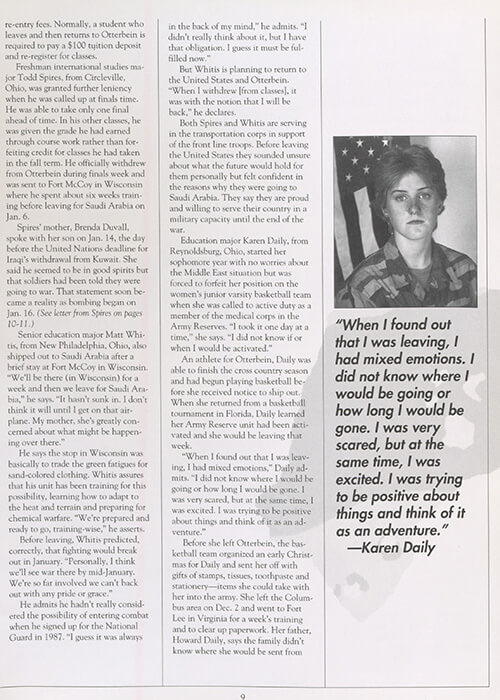
When Iraq invaded Kuwait on Aug. 2, 1990, the United States responded and many reservists were called to active duty, including seven Otterbein students. The Winter 1991 issue of Towers interviewed not only the students, but also alumni who were called to active duty, their families and supporters, and alumni with ties to the Middle East.

Many of the students were surprised to be called to active duty: “Senior education major Matt Whitis (’08), from New Philadelphia, OH, shipped out to Saudi Arabia after a brief stay at Fort McCoy in Wisconsin. He admits he hadn’t really considered the possibility of entering combat when he signed up for the National Guard in 1987.”

The issue included an interview with a student from Kuwait who appreciated the Otterbein servicemembers: “Nora AbuZeid, a freshman international business and computer science major at Otterbein, does support the United States war effort because she wants to return to her home in Kuwait . . . Her parents left Kuwait a week before the invasion with only enough packed for a two-week trip . . . (They) had no idea their country would be overrun during their absence.”

Sept. 11, 2001

Sept. 11, 2001

For the readers who are old enough to remember 9/11, it’s impossible to forget the deep impact the tragic events had on Americans across the nation, around the world, and right here at Otterbein. On campus, the community came together in a show of support, and faculty used their classes to address issues that arose after the attacks.

Otterbein Concert Choir and Vocal Ensemble

The Concert Choir and Vocal Ensemble performed “The Battle Hymn of the Republic” and “Give Me Jesus” under the direction of Gayle Walker at Ohio Stadium on Sept. 15. Ohio State was not yet in session, so Otterbein’s students were asked to sing for a crowd of 10,000 with just one day’s notice. The event raised $700,000 for victims.

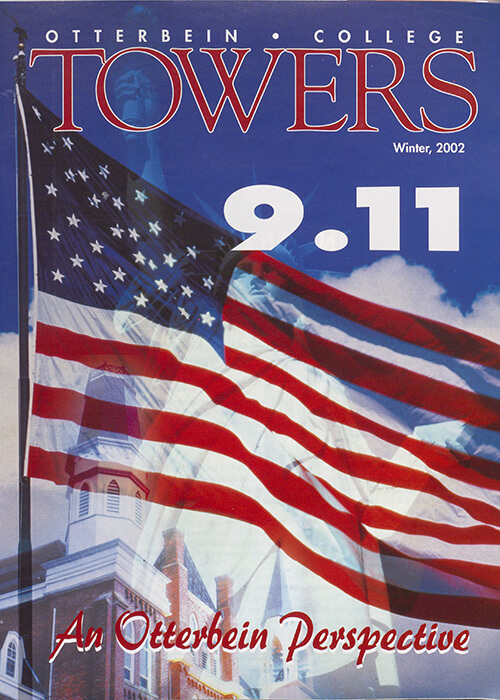
In addition to covering the campus response, the Winter 2002 issue of Towers gave alumni a chance to share their stories. Christine Witt ’00 was on the Staten Island Ferry at the time of the attack and witnessed the second plane hit the World Trade Center. Karlie Mossman ’95 was walking to work near the World Trade Center. She came out of the subway to see pieces of the first tower floating in the sky, only to witness the plane hit the second building.

Gen. Lance W. Lord ’68 (Ret.) and Maj. Gen. Glen D. Shaffer ’70 (Ret.) were both in the Pentagon when it was hit by the third airliner.

Ben Hodges ’91 lived near Ground Zero in New York City and shared his viewpoint about life during and after the attack in a moving essay.

Hurricane Katrina

Hurricane Katrina

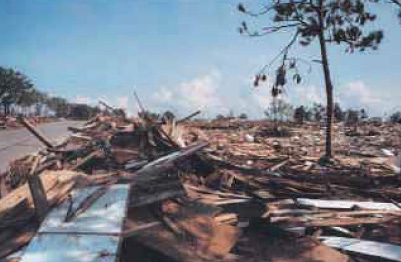
Tragedy hit the nation again when Hurricane Katrina made landfall in Louisiana on Aug. 29, 2005, and devastated the area in and around New Orleans. In the Winter 2006 issue, alumni who lived through it and students who went to help in the aftermath shared their stories.

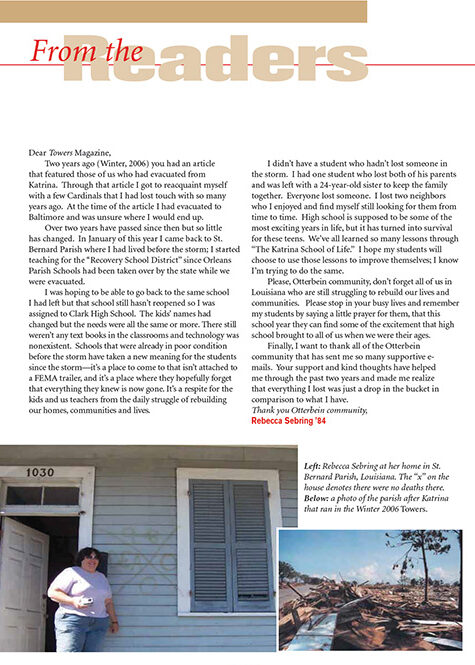
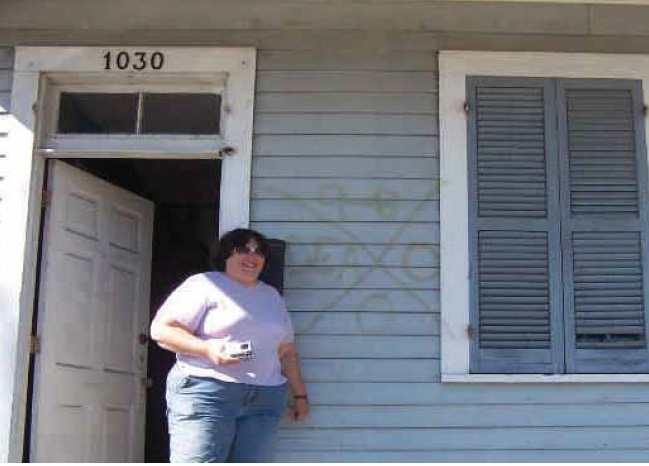
The stories included Rebecca Sebring ’84, who taught special education in the now-infamous Ninth Ward, one of the poorest and hardest hit districts, and Jay R. Hone ’75 and Marty Davis ’73, two Air Force reservists who lived across from each other as students at Otterbein and served together by chance in Louisiana after the hurricane.

Photo of Parish after Katrina that ran in the Winter 2006 Towers.

Rebecca Sebring at her home in St. Bernard Parish, Louisiana. The “x” on the house denotes there were no deaths there.

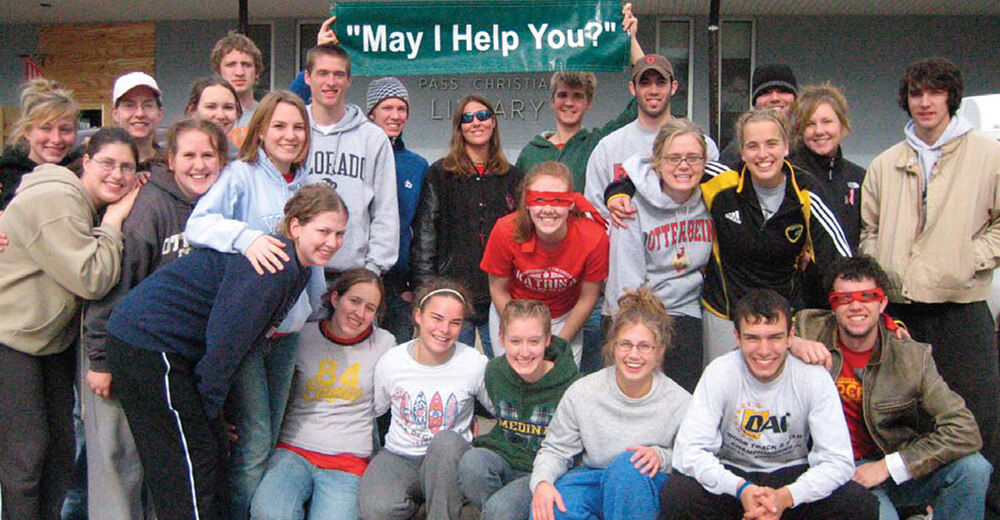
Many students were also on the ground, assisting the victims of Katrina. Sophomore Matt Lofy ’08, a U.S. Coast Guard Reservist, was called to active duty in New Orleans, while sophomore Tom Dodge ’08, a National Guardsman, was deployed to Mississippi. Additionally, 25 students from the Otterbein Christian Fellowship traveled to Mississippi during their winter break to volunteer.

Otterbein Katrina Helpers

These are just a few of the many historical events you can read about in the past 100 years of Towers. We hope this serves as a launching point for history enthusiasts to read the full articles and discover more stories of interest. Visit: digitalcommons.otterbein.edu/towers

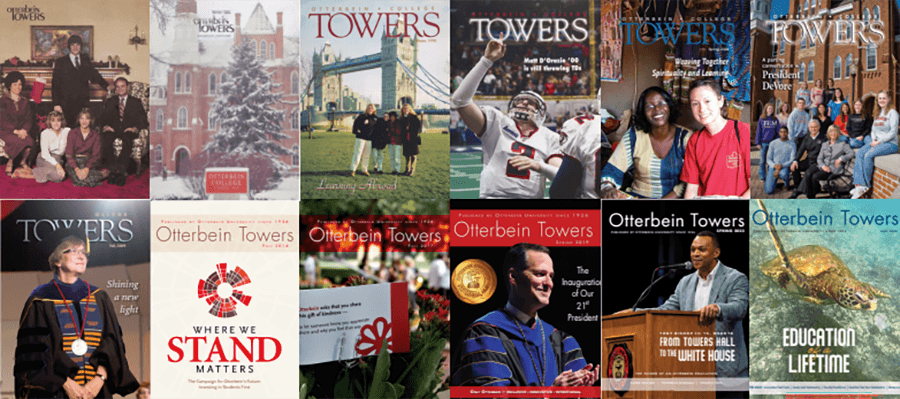
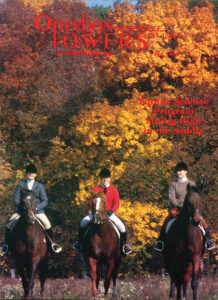
Evolution of the Cover and Nameplates

100 Years Of Otterbein Towers Editors

The list below of 100 years of Towers editors represents an invaluable wealth of institutional knowledge. Each editor uncovered unique stories, crafted articles, lists, and developed a vision for the magazine. These editors gave life and longevity to Towers and helped steer the magazine into the future. The covers below (and throughout the issue) showcase Otterbein’s history and the choices each editor made to focus on an important moment in time. These decisions give readers a glimpse into the past and will guide future readers to where Otterbein is headed.

Otterbein Towers Editors
  • H. W. Troop, Class of 1923, 1926
  • L. W. Worson, Class of 1905, 1927
  • Gerald Riley, 1939-1942
  • Wade S. Miller, 1942-1955
  • Beth Mammon ’55, 1955-1956
  • Arthur L. Schultz ’49, 1956-1965
  • Evelyn Edwards Bale ’30, 1965-1973
  • Patricia Seltzer Zech ’73, 1973-1976
  • Jo Alice Bailey Povolny ’74, 1976-1980
  • James W. Scarfpin Spring, 1981
  • Eileen M. Thome, 1981-1984
  • Jack Pietila ’62, 1984-1985
  • Andrew F. Conrad, 1985-1987
  • Patrice M. Etter, 1987-1992
  • Tuesday Beerman Trippier ’89, 1992-1995
  • Roger Routson, 1995-2018
  • Jenny Hill ’05, 2024-present, managing editor
    2014-2023, associate editor
    2005-2013, assistant editor
  • Gina Calcamuggio, 2018-present, associate editor
  • Dana Madden Vigietta ’96, 2021-present associate editor

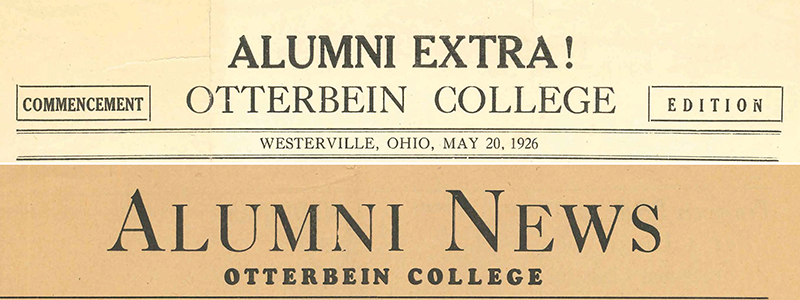
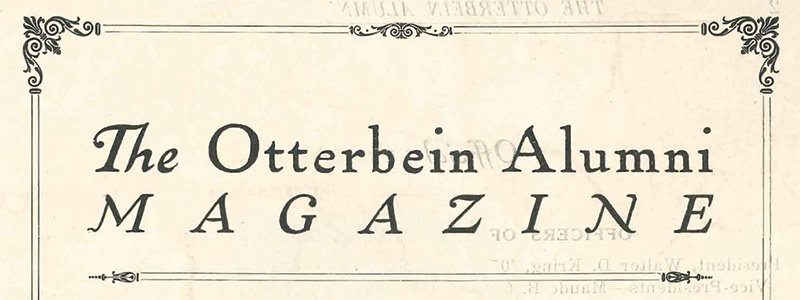
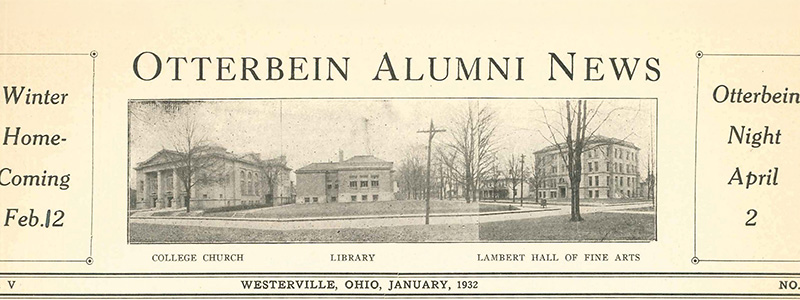
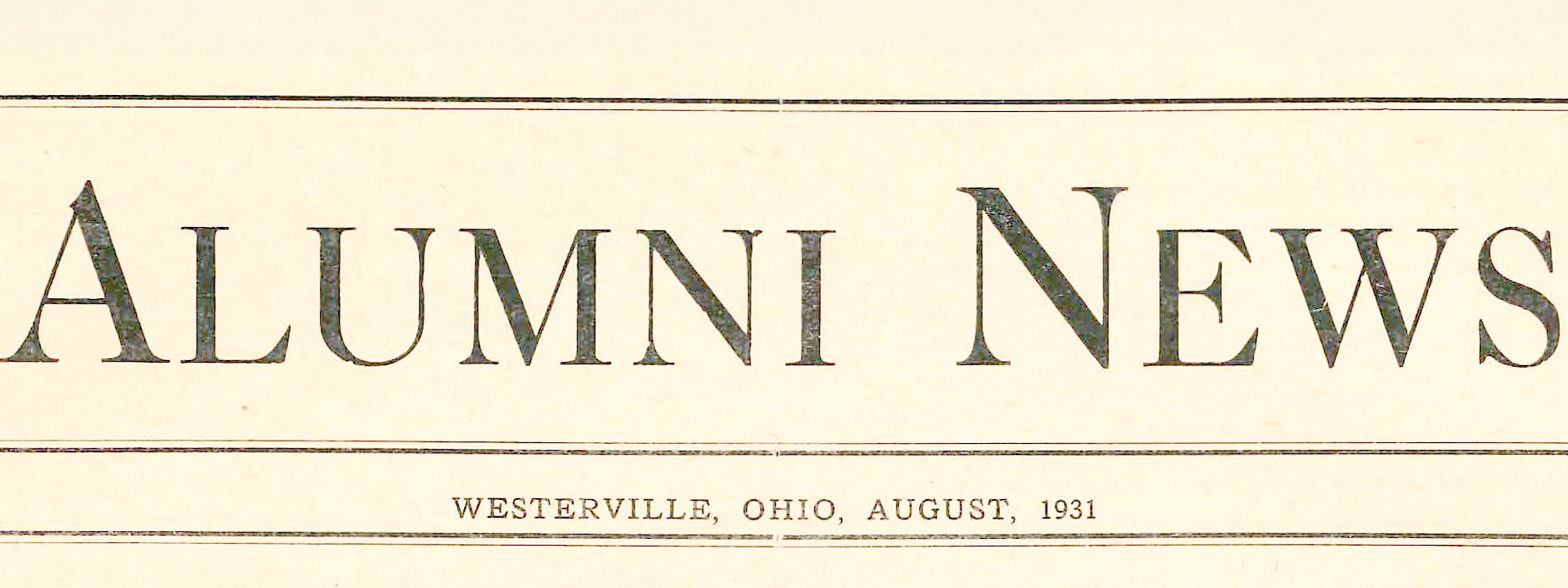
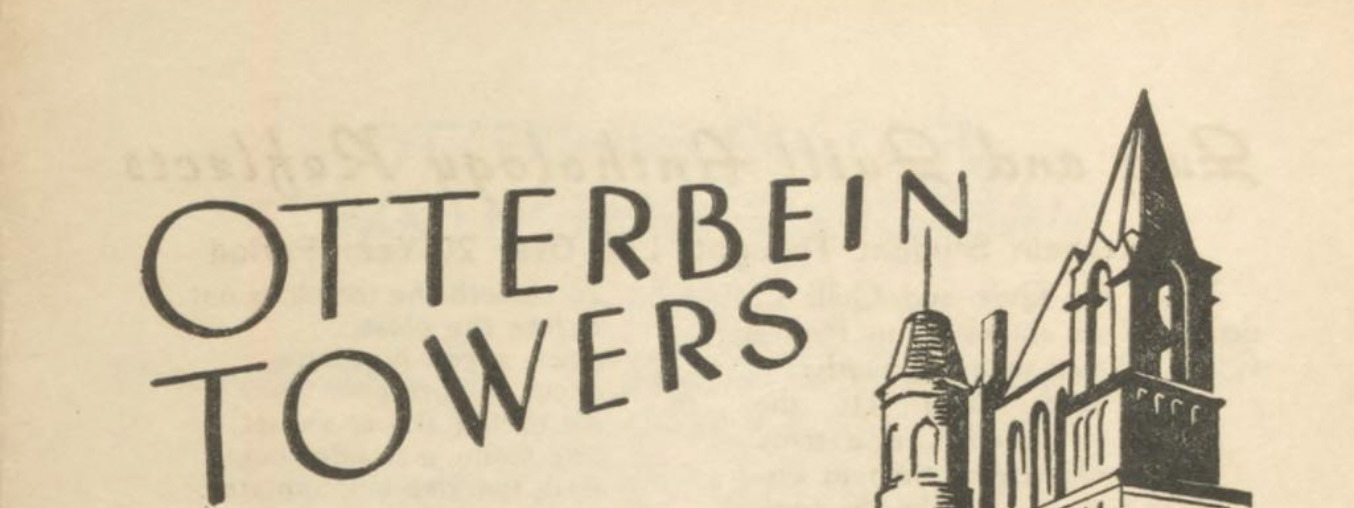
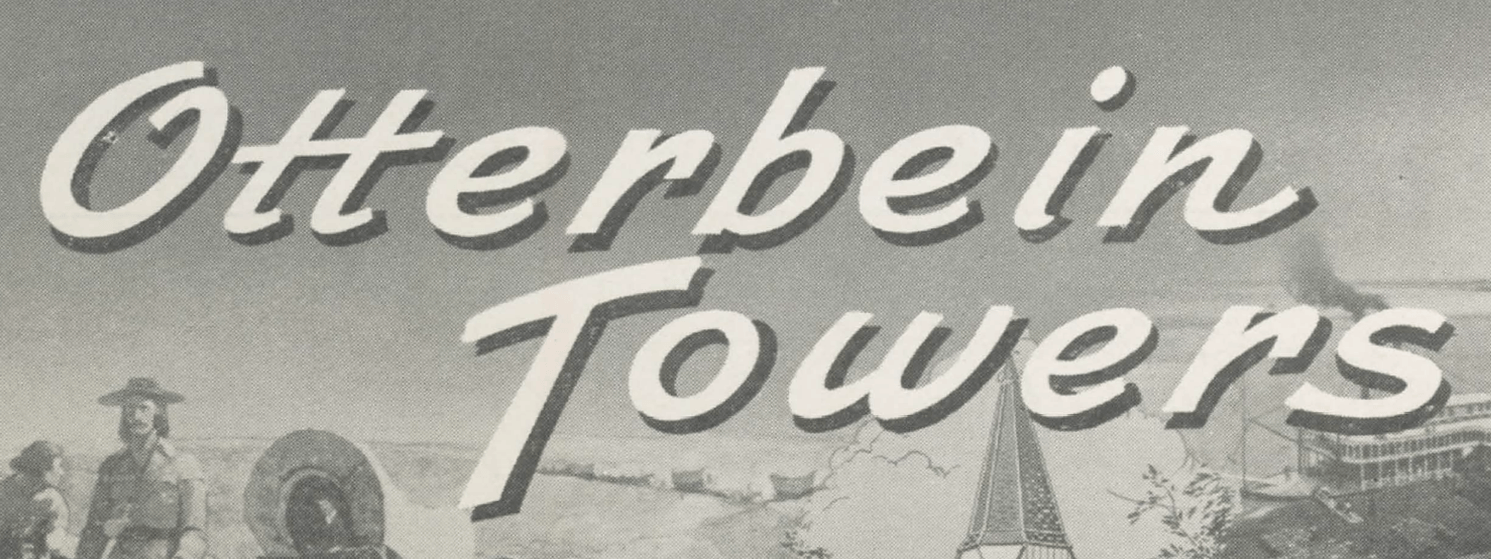
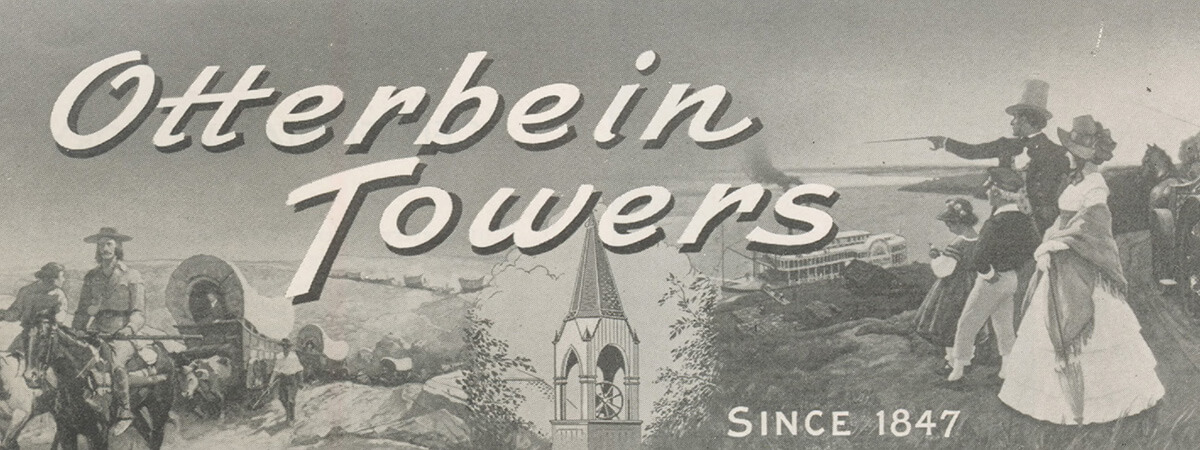
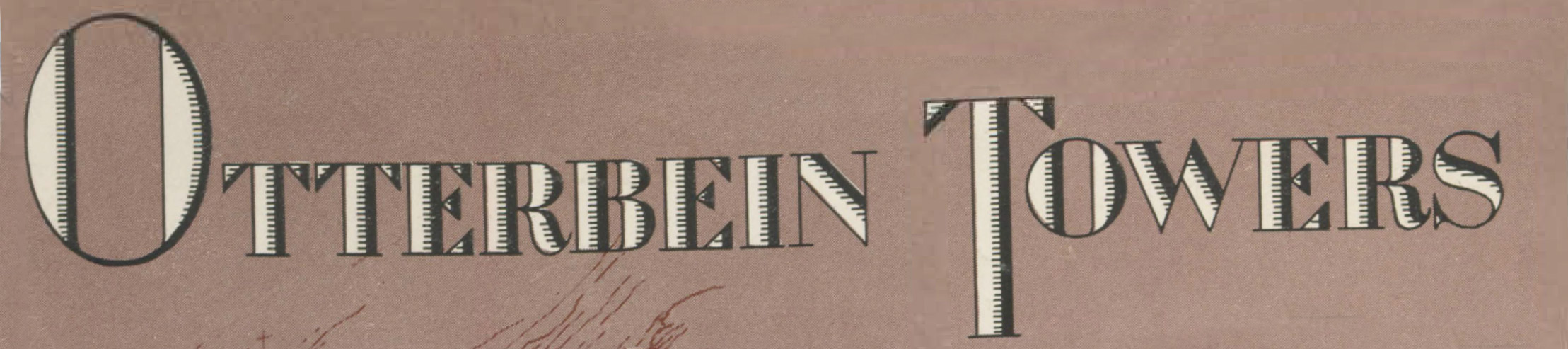
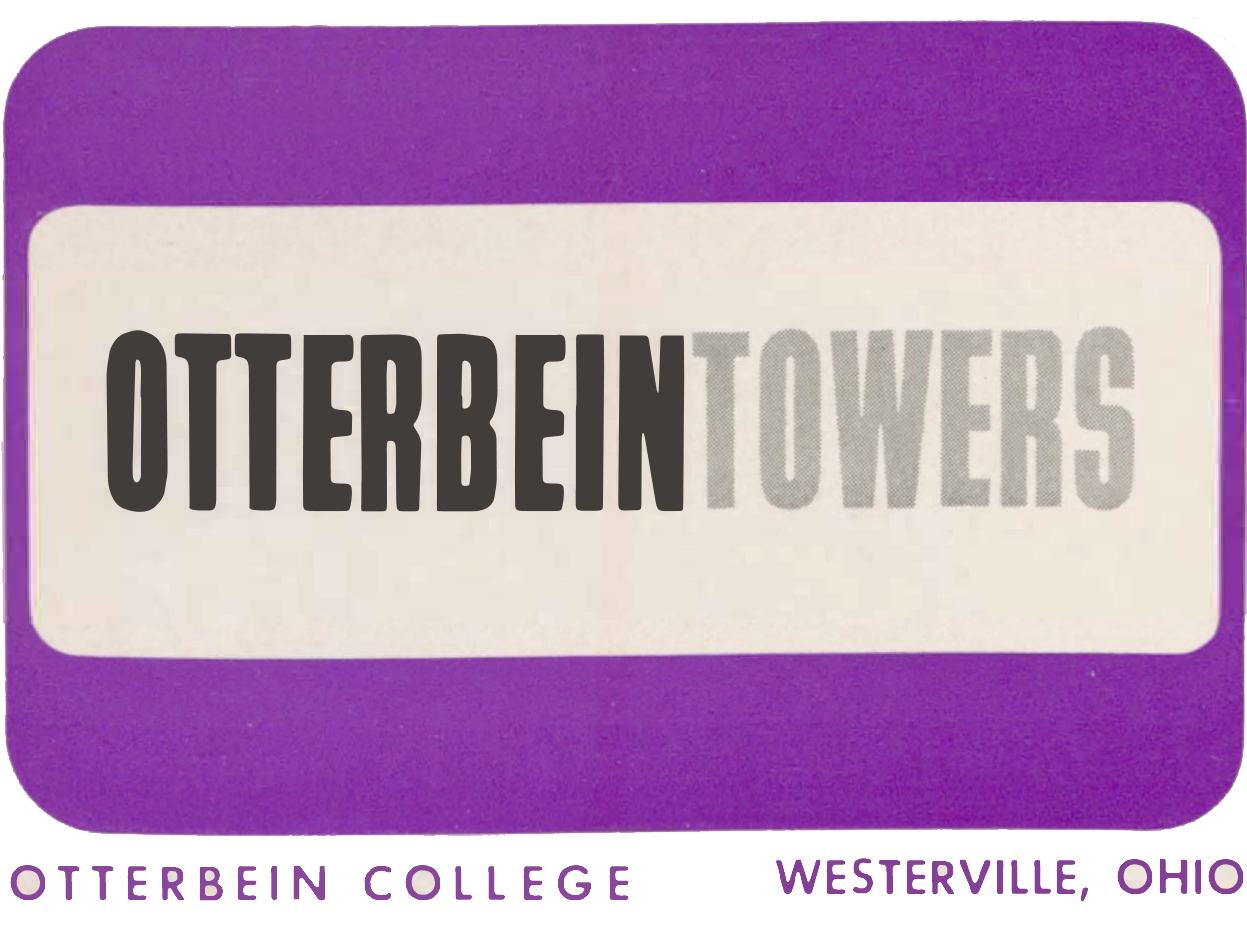
Otterbein Towers Nameplates 1926-2026

Towers magazine nameplates reflect graphic trends over 10 decades. From the “Extra Extra Read All About It!” letterpress headlines of the ’20s and ’30s, Towers Hall illustrations in the ’40s and ’50s, stylized ’60s handlettering, to the advent of ’80s desktop publishing, the nameplates reveal changing times for print publications. In the current era of digital printing, Towers has a presence online — yet another sign of the times. See more Towers archived at digitalcommons.otterbein.edu/towers.

Symposium Looks at AI Data Centers and Environmental Resources

Otterbein University held its annual Integrative Studies Symposium on Feb. 25, focusing on AI and Environmental Resources with four experts in the fields of water use, energy use, infrastructure planning, and environmental advocacy. Moderated by Professor Emeritus Kevin Svitana, Environmental Science, the symposium set the stage for lively discussions about resource needs related to Al data centers either in place or planned in central Ohio.
The experts were Michael Heyeck, an electric utility executive with 50 years of experience in the industry, as well as a former member of the Westerville City Council (1993-2025); Melanie Houston, vice president of programs for the Ohio Environmental Council; Glenn Marzluf, general manager and CEO of the Del-Co Water Company; and Brandi Whetstone, director of sustainability of the Mid-Ohio Regional Planning Commission.