Megan Chawansky Explores the Power of Sports in Post-Conflict Communities
Posted Nov 06, 2025

Associate Professor Megan Chawansky, Department of Health and Sport Sciences, grew up surrounded by sports. Her father was a coach and physical education teacher, and athletics became a central part of her identity.
For years, she thought she would play sports as long as she could or coach at the college level. But she began to feel pulled in another direction. “I got to the point that, while it is great to help elite athletes become better and push themselves, I just kind of started falling out of love with that,” Chawansky said. “I was more interested in the other experiences I was having; I would look back and think about the people I met through my teams or the places I got to travel.”
Her interests led her to research and become involved with programs utilizing sport for peace and conflict resolution. “It felt more like my calling to help with those kinds of programs versus helping an athlete to jump higher,” Chawansky said.
Her family history deepened this interest. Chawansky’s father immigrated to the United States from Ukraine, and his stories of physical activity in displaced persons camps after World War II shaped her perspective.
“I was waiting for these horrible family memories to come through, but he talked about skiing and some of the sports stuff he did. That stuck out to me when I became interested in where I came from and what my family history was all about. What keeps people going in times of war? What gives them hope when everything is uncertain? I think sports and physical activity gave their lives some meaning,” Chawansky said.
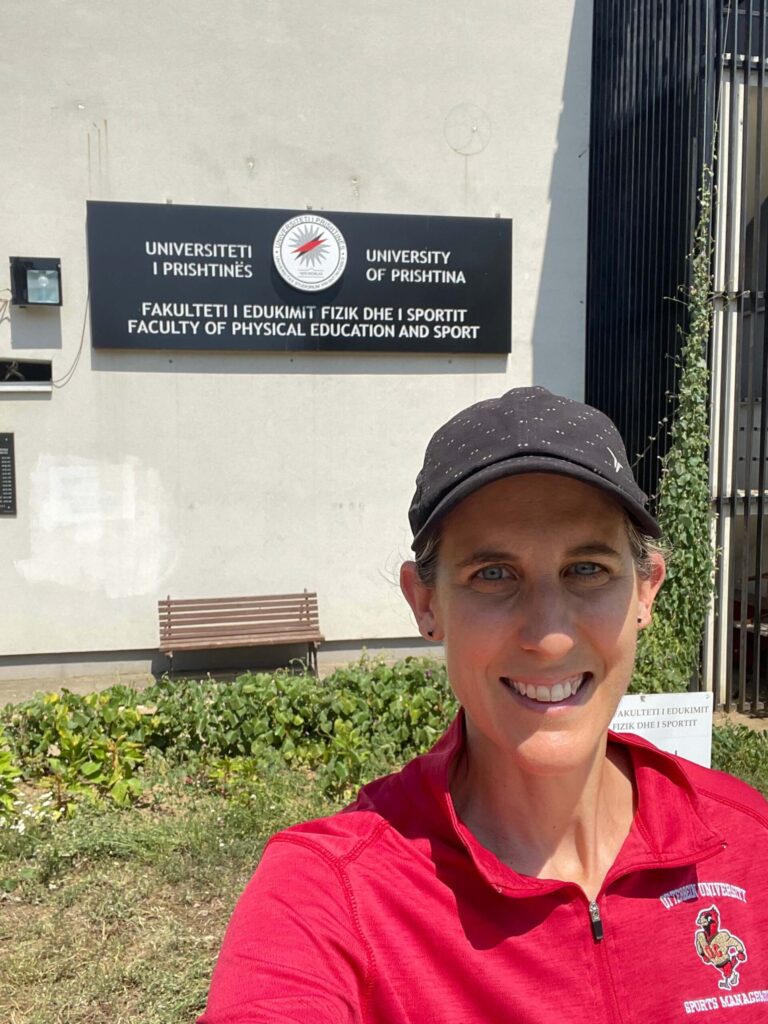
Now Chawansky has earned a prestigious Fulbright Fellowship to travel to Kosovo in fall 2025 to study how sport can be used in post-war communities. Her original plan was to conduct research in Ukraine, but the opportunity in Kosovo allows her to explore related questions in a post-war environment.
“When I saw this direct commitment to translate findings to Ukraine and make partnerships with Ukrainian universities, I think it is the closest I can be to helping Ukraine without being there. The people of Kosovo have their own struggles, their own legacy of conflict, so I think there are things that can translate and can be applied in Ukraine,” Chawansky said.
Her research will focus on women and girls.
“They have always been my focal point just because I think sport is still very gendered and we still have a lot of work to do to understand women’s experiences. There is something about the conflict in Kosovo that has been gendered as well. How do you regain strength when you have been through something like this? For a lot of people, physical activity, sport, and exercise can be a way to feel stronger physically and then mentally, as well,” Chawansky said.
Chawansky plans to bring her experiences back to Otterbein through classes, presentations, and student engagement.
“I am excited to represent Otterbein in Kosovo. I hope people feel like their story and what they are doing is really important. And for my students, I hope they become curious about the sporting world. A lot of times we can be U.S.-focused in sports, but there is a lot of other stuff going on out there,” Chawansky said.
