Neptune Blends Science and Art to Study Amphibians and Inspire Students
Posted Sep 04, 2025
By Kennedy Berry ’27
When Otterbein alumnus Troy Neptune ’17 started college, he took on two different paths, science and art. Since then, he’s built a career in both fields and is now a professor at the Cleveland Institue of Art (CIA) who will soon be researching amphibians in Spain on a prestigious Fulbright U.S. Scholar Program Postdoctoral Award.
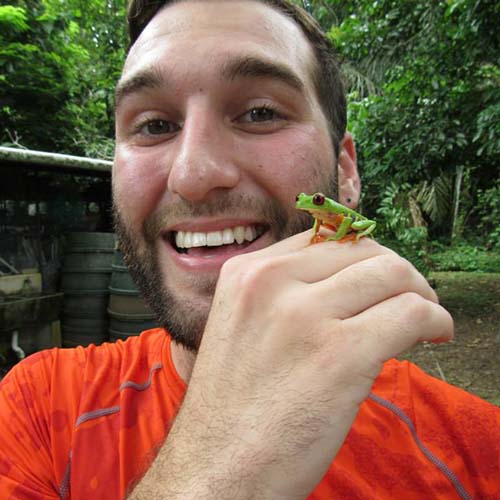
His project will focus on how light pollution affects amphibians. More specifically, how artificial light at night interferes with the natural cycles animals rely on, like knowing when to hibernate or breed based on how long the days are.
“Photoperiod, the length of daylight throughout the year, isn’t changing,” Neptune said. “But climate change is messing with temperature, so animals are getting mixed signals. That confusion can throw off their entire rhythm.”
His research in Seville, Spain, connected directly to work he did during his doctorate program at Case Western Reserve University, where he studied how frogs respond to temperature, light, and other environmental changes. He completed his doctorate degree in 2024. But his interest in amphibians started long before that, back at Otterbein.
Neptune began college as a Pre-Med major but later switched to Zoo and Conservation Science. His journey into research started with a simple opportunity: helping a professor collect frog eggs.
“Professor Sarah Bouchard posted something saying she needed frog eggs for a class. I thought, ‘Yeah, I can do that,'” he said. “That turned into lab work, then a research trip to Panama, then an honors project studying frogs. That one small thing led to everything.”
Bouchard’s mentorship left a lasting impact. “She was the reason I got into research and the reason I wanted to teach,” he said. “She’s an incredible professor and still someone I stay in touch with.”
While studying Zoo and Conservation Science, Neptune also double-majored in studio art. Though he kept art and science mostly separate for a while, he’s found ways to blend them more recently.
“Science is actually super creative. You’re constantly figuring out how to ask questions and test ideas,” he said. “And I’ve always approached my art in a detailed, almost scientific way. Now I get to bring them together.”
That combination of skills is what makes his current job so unique. As a professor at CIA, he teaches science courses to art students, showing them how nature, biology, and climate science can influence their creative work.
“Being at CIA has been amazing. The students are so talented. Walking through the building, you’re surrounded by incredible art. It’s impossible not to be inspired.”
Looking ahead, Neptune hopes to keep building a life that includes both teaching and research.
“I’d love to return to Spain for more research in the future. But right now, I’m just really thankful that I get to do both of the things I care about.”
For students trying to balance multiple interests or figure out what they want to do, he says the key is persistence.
“It was hard being a double major. There wasn’t any overlap, so I had to take a lot of extra classes,” he said. “But I always dreamed of combining art and science, and now I get to do that. It just took time.”
He also encourages students to speak up, connect with people, and not wait around for things to happen.
“A lot of my career has come from talking to the right people at the right time. You have to reach out, make connections, and follow up. That’s how you get in the room.”
Neptune grew up on a cattle farm in southeastern Ohio and was a first-generation college student. Looking at where he is now, he knows how much work it took, but he also knows how special the journey has been.
“I’m so grateful. I’ve worked hard, but I’ve also had amazing mentors and a lot of support,” he said. “I still can’t believe I get to do what I do. It really feels like a dream come true.”