The Army Changed Everything for This Veteran
Posted Nov 11, 2026
The Army Changed Her Life, and Now She’s Changing Students’ Lives
Selethia Benn has spent her entire career in service to others. From proudly serving her country in the U.S. Army to serving Otterbein students as the director of the Office of Social Justice and Advocacy (OSJA), she has always put the common good at the forefront — but it didn’t necessarily start out that way.
We asked her to share her story in her own words.
Q: What inspired you to join the military?
Benn: Well, my reason for joining the military probably isn’t the inspirational story people expect, but it’s certainly an honest one!
Education was always extremely important to my parents. My brother and I knew they were committed to paying for our college education, but they had one very clear rule: If we didn’t receive passing grades, we were on our own financially.
After transferring to the University of Cincinnati in 1999, I became a little more interested in the social side of college than the academic side. I was enjoying the parties and everything else college had to offer, and my grades reflected that!
By December 2000, I hadn’t passed all my classes, and my parents stood firm on their word. They welcomed me home but made it clear I wasn’t going to sit around doing nothing, and they were no longer paying for college.
So, in February 2001, I joined the Army. And I’ll be completely transparent: I wanted the enlistment bonus and the promise of having my education paid for! That’s it, and that’s ALL!
What I didn’t realize was that I was signing up for an experience that would change the entire trajectory of my life.
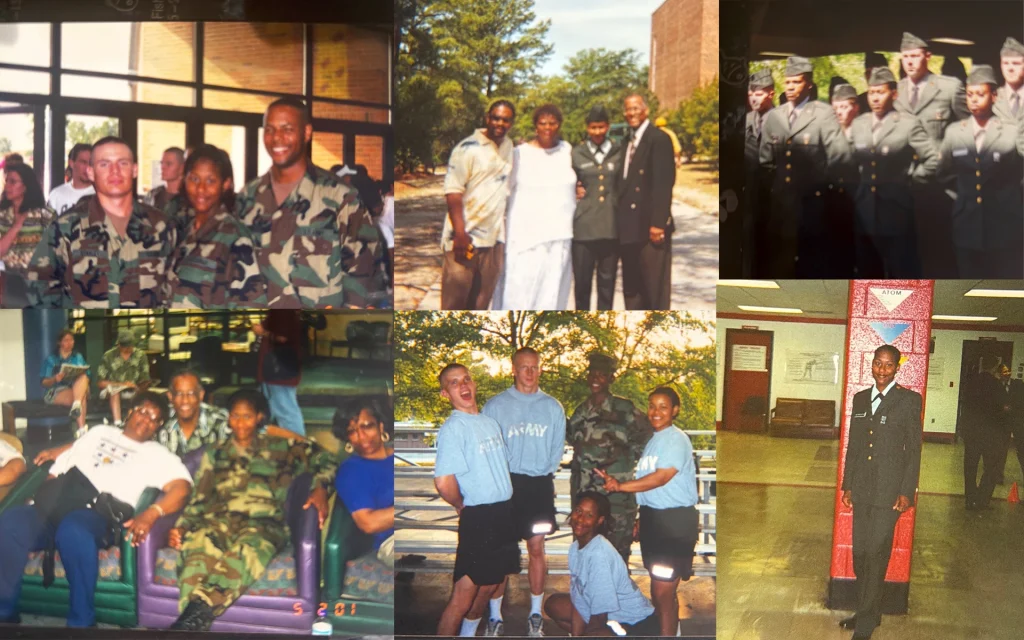
Q: What are you most proud of when you look back on your service?
Benn: What I’m most proud of isn’t necessarily something I accomplished while wearing the uniform. It’s the person I became because of the experiences I had while wearing it.
Now, I should probably start by admitting that I wasn’t exactly the model soldier when I first joined the Army! I was young, rebellious, and apparently convinced that following orders was optional. Needless to say, the Army had a few things to say about that! I found myself on restriction, assigned extra duty, and even working overnight staff duty cleaning because I couldn’t seem to follow directions. Let’s just say I wasn’t quite the well-oiled machine you see today! #welistenandwedontjudge!
But 2001 changed everything for me.
Between experiencing 9/11 while serving in the military, participating in training at the National Training Center in California, and learning some lessons the hard way, my perspective on life began to shift.
I started to understand that discipline wasn’t simply about following orders, accountability wasn’t just about avoiding consequences, and responsibility meant recognizing that my decisions could affect people beyond myself.
And I think the greatest evidence of that transformation is what happened afterward.
After leaving the military, I returned to school and earned my associate’s degree, followed by my bachelor’s degree, master’s degree, and education specialist degree. Today, I’m pursuing my doctorate.
The same young woman whose parents stopped paying for college because she failed classes eventually became a teacher, counselor, principal, superintendent, and now a university director. If someone had told that rebellious 20-year-old soldier where she’d end up, she probably would have laughed!
So, when I reflect on my military service, I’m most proud that I didn’t let who I was at 20 determine who I would become.
The Army didn’t magically transform me overnight, but the experiences, challenges, and responsibilities I encountered during that time helped me recognize that I was capable of becoming so much more.
And perhaps that’s why I’m so passionate about working with students today. I understand that the person someone is at 18, 19, or 20 isn’t necessarily the person they’ll become at 30, 40, or beyond. Sometimes all it takes is the right experience, the right opportunity, or someone willing to see potential that hasn’t fully developed yet.
Q: Were there skills or lessons you learned in the military that you still rely on in your work today?
Benn: Absolutely! And I think the biggest lesson was ACCOUNTABILITY! The Army figured out pretty quickly that I was going to need a few additional lessons in that department before things finally “clicked”!
But the lesson that has stayed with me most is that accountability goes both ways. If I’m going to hold someone to a standard, I’d better be willing to hold myself to that same standard. You can’t demand excellence, consistency, and follow-through from others while giving yourself a free pass.
I also learned that leadership is less about what you tell people to do and more about what they’re watching you do. And having spent much of my career in leadership, I’ve learned that credibility isn’t something you automatically receive because of a title. You earn it through your actions.
That’s something I carry into my work at Otterbein. I believe in being fair, being direct, and following through on what I say I’m going to do. I don’t expect perfection from anyone, including myself, but I do believe we should be willing to own our decisions and make things right when we get something wrong.
And if I tell a student or colleague something they don’t particularly want to hear, it’s usually because I care enough not to tell them what they simply want to hear. Sometimes leadership requires being the person willing to have the conversation everyone else is avoiding. Trust me, those aren’t always the most popular conversations, but they’re often the most necessary.
Q: How has your military experience shaped the way you approach your job and relationships with colleagues?
Benn: The military taught me that you don’t have to think alike, come from the same background, or agree on everything to work together toward a common goal.
It also taught me that everyone brings something different to the table, and sometimes the person with the best idea isn’t the person with the highest rank or the fanciest title.
As someone who once struggled with following directions, I can also appreciate the importance of explaining the WHY behind expectations. People are much more invested when they understand the purpose of what they’re being asked to do. And quite frankly, “because I said so” didn’t work particularly well on me, so I try not to make that my leadership strategy.
I value honesty, teamwork, communication, and genuine relationships. I don’t need everyone to agree with me, and I certainly don’t expect people to think exactly as I do. In fact, I appreciate colleagues who bring different perspectives and aren’t afraid to challenge my thinking.
At the end of the day, I believe the strongest teams are built when people feel respected, know their contributions matter, and understand that we’re working toward something bigger than ourselves.
Q: What do you enjoy most about being part of the university community?
Benn: The students, of COURSE!
I love the energy, personalities, perspectives, and sometimes downright interesting conversations that come with working with college students. No two days are ever the same, and I genuinely enjoy that.
What I appreciate most is having the opportunity to build relationships with students beyond the classroom. I get to see their creativity, hear their ideas, challenge their thinking, and occasionally remind them that just because something sounds like a good idea at 2:00 a.m. doesn’t necessarily mean it is!
There’s something incredibly rewarding about watching young adults discover their voices, develop confidence, and begin recognizing the influence they can have on the world around them.
And I love that the learning goes both ways. I may have years of experience in education, but these students teach me things all the time. Sometimes it’s something profound, and sometimes it’s a new phrase or trend that reminds me I’m not nearly as young as I think I am!
That’s what makes being part of a university community so enjoyable. I’m surrounded by people who are constantly learning, questioning, challenging, and evolving. And I get to be part of that process.
Q: How do you typically observe or celebrate Veterans Day?
Benn: Veterans Day is a time for reflection, gratitude, and recognizing the sacrifices made by those who have served, as well as the families who supported them along the way.
For me, it’s also an opportunity to appreciate the different paths that lead people into military service and the experiences that stay with us long after we’ve taken off the uniform. Every veteran has a story, and I think there’s something meaningful about taking the time to hear those stories, especially from people whose experiences were different from my own.
I use the day to reflect, acknowledge fellow veterans, and appreciate how that chapter of my life helped shape the person I am today.
Ultimately, Veterans Day reminds me that service deserves recognition, but the people behind that service deserve to be seen and appreciated as individuals, not just for the uniforms they once wore.
Q: What does service mean to you today?
Benn: These days, service means showing up for people, doing what needs to be done, and sometimes doing things that aren’t technically in your job description. And if you work in education, you already know that last part happens just about every day.
I’ve learned that service isn’t always some grand gesture or heroic act. Sometimes it’s answering a phone call when you really don’t have time, advocating for someone when the easier option would be to stay quiet, or having an uncomfortable conversation because you know it’s the right thing to do.
For me, service also means being the person who says, “Okay, let’s figure this out,” when everyone else has already decided something can’t be done.
I think that’s what I enjoy most about the work I do today. I get to be a resource, a problem-solver, an advocate, and occasionally a professional reminder that just because something has always been done a certain way doesn’t mean we have to keep doing it that way!
I’ve also learned that service isn’t about being everyone’s superhero or having all the answers. Sometimes it’s about listening, making connections, removing barriers, or simply making sure someone knows they haven’t been overlooked.
At this stage in my life, I don’t measure service by a uniform, a title, or how many people know what I’ve done. I measure it by whether I’ve made someone’s situation a little better, opened a door that might otherwise have remained closed, or helped someone see possibilities they hadn’t considered.
And if I can do all of that while keeping my sense of humor, speaking my mind, and occasionally reminding people that “no” isn’t always the final answer, then I think I’m doing pretty well!